The ski resort at the end of a Seoul subway ride: Elysian Gangchon is 61 minutes and 2,650 won from Sangbong Station
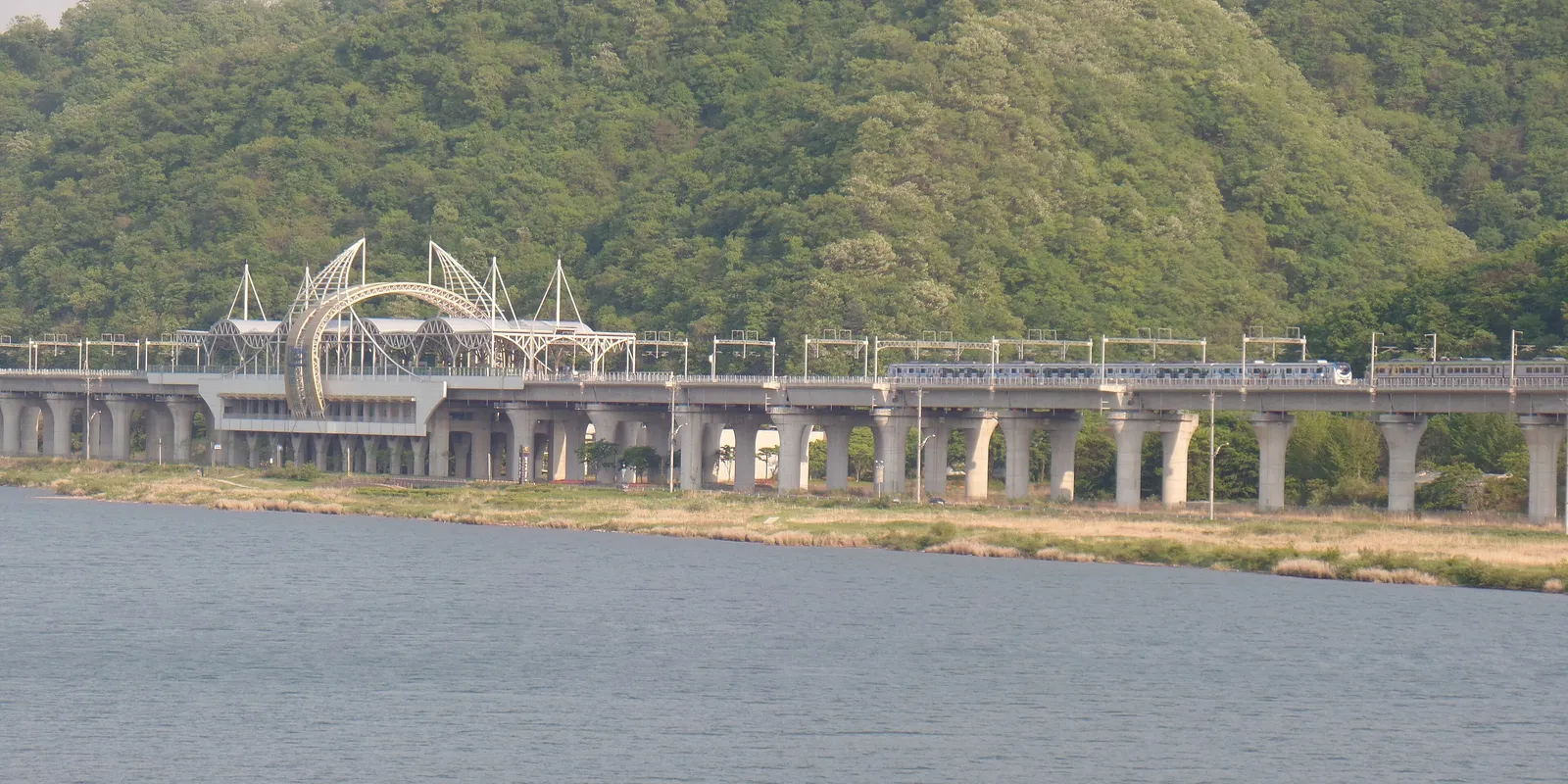
Elysian Gangchon's slopes are 16 stops down the Gyeongchun Line from Sangbong, on the same T-money card you use in Seoul. The resort in Chuncheon, Gangwon-do, describes itself as the only ski resort in Korea with a train station inside its grounds, and the station is an ordinary stop on the Gyeongchun Line of the Seoul metropolitan railway: Baegyang-ri (백양리). From Sangbong, where Line 7 meets the Gyeongchun Line, the ride is 61 minutes and 2,650 won with no change of train. Every figure here comes from the resort's own site, Korail's timetables and fare table, the Seoul Metro route finder and VisitKorea, all read on 3 November 2026. One thing was still missing on that date: the resort had not posted its 2026-27 opening day.
Where in Seoul do you board for Baegyang-ri, and how long does it take?
Board a Chuncheon-bound Gyeongchun Line train at Sangbong or Cheongnyangni and get off at Baegyang-ri, 16 stops from Sangbong. The Seoul Metro route finder gives 61 minutes and 60.0 km from Sangbong, and 75 minutes and 64.0 km from Cheongnyangni on Line 1. Both cost 2,650 won with a transport card, or 2,750 won on a single-journey ticket. The Gyeongchun Line is part of the same fare system as the Seoul subway, so a T-money card loaded for the city works all the way to Chuncheon, and the transfer at Sangbong or Cheongnyangni counts as one journey.
Korail's weekday timetable in force from 1 September 2026 lists 45 trains a day that run through Sangbong to Baegyang-ri, usually 20 to 30 minutes apart, with a few gaps of up to about 50 minutes in mid-morning and after 20:00. The first passes Mangu, the stop after Sangbong, at 05:11 and reaches Baegyang-ri at 06:11; the last passes Mangu at 23:19 and arrives at 00:19. On weekends and public holidays there are 42, from 05:31 at Mangu (arriving 06:31) to 23:13 (arriving 00:13). Some trains start at Cheongnyangni and pass through Sangbong, so either station works as a starting point.
Is the ITX-Cheongchun faster, and does it stop at Baegyang-ri?
The faster ITX-Cheongchun train does not stop at Baegyang-ri in the current timetable, so it only helps if you ride it to Gapyeong and change to the Gyeongchun Line for the last two stops. In Korail's ITX-Cheongchun timetables effective from 9 February and from 1 September 2026, the Baegyang-ri row is blank on every train. The resort's own directions page says the same in its way: for ITX riders it lists "get off at Gapyeong or Gangchon, move to Baegyang-ri on the Gyeongchun Line, then take the shuttle."
Riding the ITX to Gapyeong and doubling back works like this. The first weekday ITX calls at Cheongnyangni at 05:54 and reaches Gapyeong at 06:34, a 40-minute ride; Korail's fare table lists 5,700 won from Cheongnyangni and 6,900 won from Yongsan to Gapyeong. From Gapyeong the Gyeongchun Line takes 7 minutes and 1,550 won to Baegyang-ri. Three weekday ITX trains also stop at Gangchon, the next station past Baegyang-ri, arriving at 13:57, 17:06 and 21:42; from there it is one stop back. Korail's fare table does carry a Yongsan to Baegyang-ri fare of 7,700 won, which is what you would pay if seasonal stops return. Korail has added them before: a Korail press release of 1 December 2015 announced temporary ITX stops at Baegyang-ri from 11 December to 1 March for skiers, with 8 stops on weekdays, 16 on Saturdays and 14 on Sundays, and a 21:15 train from Yongsan for night skiing. The resort's current discount table still has a row for ITX-Cheongchun ticket holders, 40% off lift passes and 50% off rental at the counter for the ticket holder only. Whether stops come back this winter is something only a Korail notice can tell you; as of 3 November 2026 there was none.
What happens between Baegyang-ri Station and the slopes?
You take the resort's own shuttle from the station. The resort's directions page puts it in two steps: get off at Baegyang-ri, then "use the internal circulation shuttle to enter the resort." Its shuttle page names the loop as Baegyang-ri Station to Challenge House, the building that serves the beginner slopes, with a second loop running station, condominium, station when the ski buildings are closed.
There is also a free shuttle from the Seoul area on weekends and public holidays, and the resort's conditions are strict enough to plan around: no reservations, one bus per route, and if the bus is full you do not board. The pickup list on the resort's shuttle page runs through Seoul Station, Gangnam, Hongik University, Sadang, Konkuk University, Nowon, Dongdaemun, Yeouido and Sangbong, with more stops in Gyeonggi and Incheon. The dates shown on 3 November 2026 were still last season's, running from 13 December 2025 into early March 2026, so check the page for this winter's dates before relying on it. The train has no such limit.
When does the 2026-27 season open, and how is the day divided?
As of 3 November 2026 the resort had not announced its 2026-27 opening day. Its ski page still listed the operating period as 5 December 2025 to 8 March 2026, and the opening-day announcement the resort issued on 1 December 2025 put the first day of last season at 6 December. Last season's announcement came on 1 December, so an early-December notice would fit that precedent, but it is one precedent, not a date.
The daily rhythm is set out on the resort's slope-status board, which splits the day into five blocks: 09:00 to 17:00, a grooming break from 17:00 to 18:30, then 18:30 to 22:00, 22:00 to 00:00 and 00:00 to 03:00. Which blocks actually run on a given day is published in the resort's notices. The unattended ticket kiosks stop selling an hour before each late block ends: 23:00 for the night block and 02:00 for the late-night one. Match that against the trains and the picture is clear. The last Gyeongchun Line train back towards Seoul leaves Baegyang-ri at 23:03 on weekdays and 23:04 on weekends, so the evening block to 22:00 fits a train day and the two late blocks do not. Oddly, you can arrive for the late-night block by train: the last weekday train from Sangbong gets in at 00:19.
What does a lift pass cost?
The resort's price page lists a 2-hour pass at 62,000 won on a weekday and 75,000 won on a weekend, before any discount. Weekday means Monday to Friday; weekend means Saturday, Sunday and public holidays. The page carried these figures on 3 November 2026 next to last season's dates, so a new-season update could change them.
| Pass | Where sold | Adult weekday / weekend | Child weekday / weekend |
|---|---|---|---|
| 2 hours | counter | 62,000 / 75,000 won | 50,000 / 60,000 won |
| 4 hours | counter | 72,000 / 85,000 won | 58,000 / 68,000 won |
| 6 hours | counter | 82,000 / 95,000 won | 66,000 / 76,000 won |
| 3 hours | website only | 67,000 / 80,000 won | 54,000 / 64,000 won |
| 5 hours | website only | 77,000 / 90,000 won | 62,000 / 72,000 won |
| 7 hours | website only | 87,000 / 100,000 won | 70,000 / 80,000 won |
The clock on a time pass starts when you first pass the lift gate, and the grooming break is not counted. A child means an elementary-school pupil or younger, born in 2013 or later, and children under 36 months are not allowed on the lifts. Cancelling or exchanging a ticket costs 2,000 won, and nothing is refunded once you have passed a gate. The same page's discount table lists 35% off lift passes outside peak season and 25% during it (peak last season: 20 December to 22 February), but that row sits under the "partner card" heading and applies to holders of the resort's partner credit cards (Shinhan, NH, Woori) buying at the counter; there is no general on-site discount, so without one of those cards or an ITX ticket, expect the listed price.
How much is rental, and do you need a helmet?
A full set of skis or a snowboard with boots and poles costs 33,000 won for up to 4 hours and 38,000 won for longer, and from 1 January 2026 a helmet is compulsory. Children pay 30,000 and 35,000 won. Clothing, meaning jacket and trousers, is 25,000 won for the short slot and 30,000 won for the long one; a plain helmet is 5,000 won for an adult and 3,000 won for a child. Goggles are not rented at all, and the page tells you to buy them at the sports shop, so bring your own. Rental boots run from 155 to 205 mm for skis and 180 to 320 mm for boards, and the page warns that on Saturday and Sunday the counters can run short for an hour or two around 12:00 to 14:00.
Can a visitor buy tickets online, or is there a Korean phone wall?
The resort's website sells its own tickets to members, and membership is opened with a mobile-phone identity check through a Korean certification agency, so a visitor without a Korean number buys at the counter or through a visitor platform. The sign-up page offers phone verification for general members and an email route only for GS group employees. The site itself is in Korean with a Google Translate widget for English, Japanese and Chinese. A data-only eSIM does not help here: it has no phone number to verify.
The counter is the plain route. Every pass except the website-only 3-, 5- and 7-hour ones is sold at the counter. The resort's announcement for last season also listed what it had done for foreign guests: a renovated foreigner rental house, a ski school for foreigners, a QR guide and standardised English and Chinese signage, plus a tourism product for foreign visitors built around a single-ride lift ticket. Visitor booking sites sell lift-and-rental packages for the resort too; one such listing reads "This package is for FOREIGNERS", asks for a passport to prove it, and has you collect the ticket at the Elysian International Information Booth next to Challenge House between 09:30 and 16:50. If your ticket was bought on the resort's own site, it lives in your account as a barcode that you scan at a kiosk next to the ticket office in Ski House or Challenge House.
Which slopes suit a first-timer?
Two of the ten slopes are beginner runs, both served from Challenge House: Panda, 255 m long with a drop of 21 m, and Rabbit, 342 m with a drop of 34 m. The resort says 8 of its 10 slopes are for beginners and intermediates, which is the reason it gives for its slogan that even a beginner can come down from the top. The six intermediate runs are Zebra, Dragon, Horse, Pegasus, Deer and Puma, from 342 m to 768 m long, with Deer, at 768 m, the longest run in the resort's lift table. The two expert runs below Ski House, Leopard and Jaguar, are short at 463 m and 468 m but steep, with an average gradient of 52% and 54% (about 27° and 28°) in the resort's table, against 7.9% (about 4.5°) for Panda. Lifts are lettered A1 and A for the beginner slopes and B to E for the rest, and the resort's safety rules also cover a Sunkid conveyor belt for people learning. If you snowboard, one foot must be strapped in before you board a lift.
Is there somewhere to go if you don't ski?
Yes, the Snow Hill & Fun Park is a sled park with its own tickets. The resort's price page lists a 3-hour ticket at 30,000 won for 09:00 to 12:00, 12:00 to 15:00 or 15:00 to 18:00, and a 2-hour ticket at 25,000 won for 10:00 to 12:00, 13:00 to 15:00 or 16:00 to 18:00; the 2-hour ticket is sold only on site. Sledding on the ski slopes themselves is banned. Last season's announcement added a snow playground for children and ice sleds in the kids' park.
Is Chuncheon worth the extra 19 minutes after skiing?
Chuncheon is the end of the same line, 19 minutes and 1,850 won past Baegyang-ri by the Seoul Metro route finder. A half day on the beginner slopes with a 4-hour pass, then an evening in Chuncheon, is the natural combination. If an island appeals more than a city, Gapyeong, the station for the Nami Island ferry, is 7 minutes and 1,550 won in the other direction, back towards Seoul. Either way, keep the last trains in mind: from Baegyang-ri the last train towards Seoul is 23:03 on weekdays and 23:04 on weekends, arriving at Sangbong at 00:05 and 00:06.
Which of these pages are Korean-only, and where will you be when you open them?
Nearly all of them, and you will be on a station platform or in a rental queue. The resort's notices and opening-day announcement are on its Korean website, the slope-status board and webcam are on the same site, and the shuttle page is where you learn whether the weekend bus is running; Korail's app shows which train is next. Kedanto's Korea eSIM is data only, so it cannot answer the resort's phone check, but a ticket barcode, the size chart at the rental counter and the slope board all load on it, and one line shared by hotspot covers a group in the Challenge House queue. Put it on the phone before the flight; the clock on it does not start until it connects in Korea.
Of everything the resort and Korail publish, one line was still blank on 3 November 2026: the opening day. When the resort fills it in, the 2,650-won train will already be running.
Sort your data out before you fly
You keep your SIM and add one data line. Your home number stays on your usual SIM; whether its calls and texts reach you abroad depends on your home carrier's roaming.
See eSIMs by country