Getting from Gimhae Airport to Haeundae, Seomyeon and Busan Station
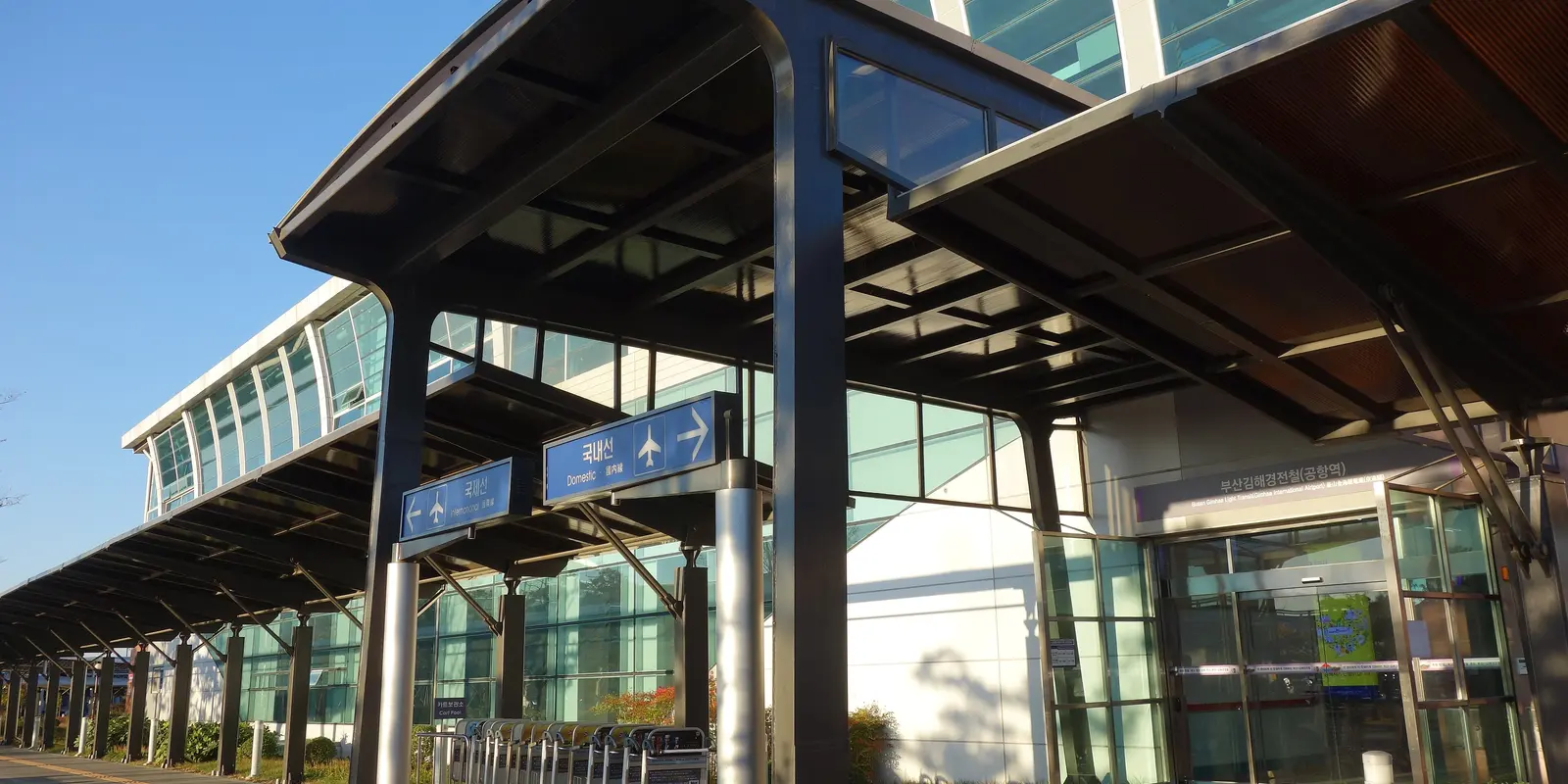
The cheapest way from Gimhae International Airport (PUS) into Busan is the Busan–Gimhae Light Rail: about 6 minutes to Sasang for Subway Line 2 (Seomyeon, Haeundae) or about 8 minutes to Daejeo for Line 3, with the whole trip costing 1,600 or 1,800 won on a transport card. The only direct buses that take full-size suitcases are the two airport limousines, 9,500 won to Haeundae and 6,000 won to Seomyeon, paid by card only. The airport's operator estimates a taxi to Haeundae at about 25,000 won. Routes, fares and times below come from Korea Airports Corporation (KAC), which runs the airport, Busan–Gimhae Light Rail (BGL), Busan Transportation Corporation's fare data and the Busan Metropolitan Government, all checked on 10 October 2026.
Should you change at Sasang or Daejeo for your part of Busan?
Sasang, for Busan Metro Line 2, if you are heading for Seomyeon, Haeundae or Busan Station; Daejeo, for Line 3, if you are heading for the north of the city. Both are three stops from Airport Station on the Busan–Gimhae Light Rail, in opposite directions. KAC's subway page names exactly these two transfers: Line 2 at Sasang and Line 3 at Daejeo. BGL's first-and-last-train table puts Sasang about 6 minutes from Airport Station and Daejeo about 8 minutes.
Which way you turn depends on where you are staying:
- Seomyeon, Haeundae, Gwangalli (Geumnyeonsan or Gwangan stations), Centum City: toward Sasang, then Line 2 heading for Jangsan. Seomyeon comes first, Haeundae near the end of the line.
- Busan Station, Nampo-dong, Jagalchi: toward Sasang, Line 2 to Seomyeon, then Line 1 toward Dadaepo Beach. Busan Station is the sixth stop after Seomyeon.
- Sajik, Yeonsan-dong and the north of the city: toward Daejeo (trains signed for Gaya University), then Line 3 toward Suyeong.
The first light rail toward Sasang leaves Airport Station at 05:33 and the last at 00:09, every day of the week, according to BGL's timetable for the station. Daytime trains run every 5 to 6 minutes, and after 22:00 every 8 to 12 minutes.
How much is the train into Busan, and do you pay twice when you change?
On a transport card you pay once: 1,600 won at the airport gate, plus 200 won more only if your subway ride falls in Busan Metro's second fare band. BGL's fare table puts Airport, Sasang and Daejeo in the same zone, so the light rail leg costs its lowest fare, 1,600 won for an adult on a transport card or 1,700 won with a single-journey ticket. Busan Transportation Corporation's fare data (in force since 3 May 2024) gives its own adult fares as 1,600 won for the first band and 1,800 won for the second on a card, or 1,700 and 1,900 won with a QR ticket.
The transfer is what keeps it cheap. BGL's fare page says that within Busan, Gimhae and Yangsan, if you tap onto the next train or bus within 30 minutes of tapping out, you pay only the highest fare among the modes you used, for up to two transfers. It adds that the 500 won surcharge for these cross-city transfers was abolished on 19 September 2025. A long ride such as Sasang to Haeundae lands in the second band, so the whole trip comes to 1,800 won.
A single-journey ticket loses all of that. BGL's passenger terms (revised April 2024) say its single-journey tokens can't be used to transfer to another line or a bus. Without a card, you buy a 1,700 won token for the light rail and then a separate Busan Metro QR ticket at Sasang, 1,700 or 1,900 won, so the same trip costs 3,400 to 3,600 won.
One condition catches visitors with a nearly empty card: the same terms say a prepaid card needs at least the second-band adult fare on it to get through the gate, which today is 1,800 won.
How late can you land and still make the subway?
The last light rail toward Sasang leaves Airport Station at 00:09, but the subway stops earlier. BGL's page for the station marks the 23:46 departure as the last one that meets Line 2 at Sasang toward Jangsan (the Haeundae direction), and the 23:57 departure as the last that meets the train toward Jeonpo, which still passes Seomyeon. Toward Daejeo, the 23:23 light rail is the last that connects with Line 3 toward Suyeong. The 00:09 train only takes you as far as Sasang.
Treat the two Sasang times as the very latest, not as a plan. BGL's own first-and-last-train page gives the last Line 2 trains at Sasang as 23:45 toward Jangsan and 00:02 toward Jeonpo, and a light rail leaving the airport at 23:46 or 23:57 reaches Sasang about 6 minutes later, after both. The two BGL pages don't agree, so if you're cutting it fine, run the trip through a map app's route search before you tap in.
Immigration and baggage take time, so a flight landing after about 22:30 can easily miss those connections. The limousines can't help by then either: the last ones leave at 21:30 for Seomyeon and 21:40 for Haeundae. That leaves a taxi, covered below.
Which limousine bus goes from Gimhae Airport to Haeundae?
Airport Limousine 1, toward Haeundae and Gijang, from Platform 3 on 1F, adult fare 9,500 won, card only. KAC's timetable lists departures from the international terminal from 07:10 to 21:40, between 20 and 80 minutes apart. The bus then calls at the domestic terminal, Namcheon-dong, Shinsegae Centum City, BEXCO, the Yachting Center, Park Hyatt Busan, Hanwha Resort Haeundae, the Dongbaek Island entrance, Haeundae Beach, the Haeundae hot spring intersection and Jangsan Station (Exit 5). Some departures end at Jangsan; the rest continue to Ananti Cove and Banyan Tree Haeundae Busan in Gijang.
The rules come from the Busan Metropolitan Government's announcements of July and December 2025:
- Payment: credit card or transport card on board, no cash. Youth fare 7,600 won and child fare 4,800 won, per KAC.
- Booking: you book in the Bustago app (an intercity bus booking app) and scan the QR code it issues as you board; seats aren't assigned. Walk-up passengers ride only if seats remain. KAC also lists a limousine ticket office on 1F of the international terminal, open 06:00–23:00.
- Luggage: two pieces per person, up to 30 kg in total, free.
- No transfer discount: the fare doesn't count toward a subway or bus transfer.
- On board: 23 seats, USB ports and Wi-Fi.
Paying in Bustago with a foreign card is new. On 7 October 2026 the payment-security firm NexOneSoft announced that the app now accepts overseas-issued cards, and the business channel MTN's report names Visa, Mastercard and American Express among the supported brands; Venture Square's report of the same announcement also lists JCB and UnionPay. That's a vendor announcement, not a notice from Bustago itself, so if your card is declined, the ticket office on 1F is the fallback.
Is there a direct bus from Gimhae Airport to Seomyeon?
Yes: Airport Limousine 2 runs to Seomyeon and Bujeon for 6,000 won, from the same Platform 3. Busan cut the adult fare from 7,500 won on 5 January 2026. KAC's timetable has 12 departures from the international terminal, the first at 07:20 and the last at 21:30, every 70 to 80 minutes. KAC lists the stops as the international terminal, the domestic terminal, Jurye Station, Dong-eui University Station, Seomyeon Station (Lotte Department Store) and Bujeon Market, and Busan says the route uses its BRT bus lanes. Buses back to the airport start from Bujeon Station.
Because the buses are 70 to 80 minutes apart, look up the next departure before choosing it over the light rail, which leaves every 5 to 6 minutes in the daytime. The bus earns its fare when your bags are heavy and a departure happens to be close.
Can you take a city bus from Gimhae Airport with a suitcase?
Only a carry-on. KAC's listing for city bus 307 quotes Busan's city bus terms: only a carry-on-size case, up to 20 kg per person and no larger than 50 × 40 × 20 cm. Bus 307 runs from Platform 2 on 1F all the way to Haeundae and Songjeong for 1,550 won on a transport card (1,700 won cash). The first bus leaves the domestic terminal at 05:15 and the last at 23:20, about every 25 minutes, but the route winds through Gupo and Dongnae, so it is the long way round to the beach. Express bus 3003 to Jagalchi and Taejongdae costs 2,100 won on a card and runs 05:00–21:30, per KAC.
What does a taxi to Haeundae or Seomyeon cost, and when does the night surcharge start?
About 25,000 won to Haeundae and 18,000 won to Seomyeon in a regular taxi, by KAC's own estimate. KAC's taxi page lists these approximate fares and times for regular and deluxe (mobeom) taxis, and notes that traffic changes them:
| Destination | Approx. time | Regular taxi | Deluxe taxi |
|---|---|---|---|
| Seomyeon (Lotte Hotel) | 45 min | 18,000 won | 32,400 won |
| Nampo-dong (Jagalchi Market) | 60 min | 20,000 won | 36,000 won |
| Haeundae (Paradise Hotel) | 70 min | 25,000 won | 45,000 won |
| Gwangalli | 70 min | 25,000 won | 45,000 won |
| Taejongdae | 80 min | 28,000 won | 50,400 won |
The meter starts at 4,800 won for the first 2 km in a regular taxi, the rate Busan has charged since 1 June 2023. Late at night it adds 20% from 23:00 to midnight, 30% from midnight to 02:00 and 20% from 02:00 to 04:00. If you want to call a cab by app, our taxi app guide covers Kakao T, k.ride and Uber.
Does a Seoul T-money card work in Busan, and is there anywhere at the airport to buy one?
A T-money card from Seoul works in Busan, and KAC's facility list shows one convenience store on the arrivals floor, a CU on 1F, open 06:00–22:00. BGL lists T-money among the prepaid cards it accepts, alongside Busan's own Hanaro and Mybi cards and Cashbee, and names T-money among the cards that get the transfer discount. The Busan Metropolitan Government lists convenience stores and subway stations as places to buy a prepaid card, and adds the light rail stations and Busan Bank for top-ups.
The same list puts the CU on 1F of the international terminal alongside a BNK Busan Bank branch (09:00–16:00), the limousine ticket office and an airport information desk (06:00–23:00). It doesn't say whether the CU stocks transport cards. If it has none, the token machines at Airport Station still get you to Sasang, and you can buy a card at the first convenience store in the city.
A Seoul Climate Card is no help here. It only covers Seoul, as explained in our T-money and Climate Card comparison.
What does the terminal's free Wi-Fi cover, and what else is on 1F?
Across the terminal's waiting areas, according to KAC. Its tips page for Gimhae lists a free network called "Public WiFi FREE" there and says you join it from your phone's Wi-Fi settings. The page gives no more detail than that. KAC's facility list also shows a pocket Wi-Fi rental counter (Wifi Dosirak) and roaming counters for SK Telecom, KT and LG U+ on 1F of the international terminal, all open 06:00–22:00, with more carrier counters on 3F until 21:30. Once you're on a limousine, Busan says the buses have their own onboard Wi-Fi.
Why is the limousine the part of the trip that needs a signal?
Because its seats are booked in an app and the next bus can be over an hour away. Busan's 2025 announcement says the limousines carry a bus information system, so KakaoMap and NAVER Map show their live position and arrival times when you search the route name. Booking the seat in Bustago, finding Platform 3 or the light rail walkway, and checking whether you still make the last subway at Sasang all happen on your phone, often while you're still waiting for your bags. KAC describes its free Wi-Fi as covering the terminal's waiting areas, so once you step out to Platform 3 or onto the light rail walkway, don't count on it. What NAVER Map and KakaoMap each show is compared in our guide to Korean map apps.
A Kedanto Korea eSIM covers that stretch between the belt and the bus using SK Telecom's and LG U+'s networks, and a travel companion can run off your phone's hotspot instead of hunting for the terminal Wi-Fi. What it can't do is take a text: there is no Korean mobile number on it, so a code sent to a Korean number won't reach you this way. Until it's installed you can get all your money back, and installing it before you fly keeps the QR code away from the carousel.
Which route suits a late landing, heavy bags or a tight budget?
The light rail and subway for almost everyone, the limousine when you have heavy bags and it suits the timetable, a taxi after a late landing. At 1,800 won on a card, the train is the cheapest route to Haeundae and the most frequent, every 5 to 6 minutes in the day. The 9,500 won limousine saves you the change at Sasang, but only if a bus is due. The taxi costs over 13 times the train fare but doesn't depend on the last-train connections.
The saving shows at Sasang. You tap out of the light rail, follow the signs to Line 2 and tap in again well inside the 30-minute window, so the card counts both rides as one trip and the journey to Haeundae comes to 1,800 won in all. Someone who bought a token at the airport has to stop at the Sasang ticket machines first, and pays 3,600 won for the same ride.
Sort your data out before you fly
You keep your SIM and add one data line. Your home number stays on your usual SIM; whether its calls and texts reach you abroad depends on your home carrier's roaming.
See eSIMs by countryRead next
- Before a concert at Gocheok Sky Dome: sort out the ride home from Guil Station first
- Gwangjang Market: hours, the Sunday catch, and why to bring cash
- The cinema above Seoul's herbal market that became Starbucks Gyeongdong 1960
- Transiting through Incheon: whether to turn on a Korea eSIM depends on leaving the airport