The cinema above Seoul's herbal market that became Starbucks Gyeongdong 1960
Starbucks Gyeongdong 1960 is a Starbucks Korea café built into the auditorium of the former Gyeongdong Theatre, on the 3rd and 4th floors of Gyeongdong Market's main building at 3 Gosanja-ro 36-gil, Dongdaemun-gu, in north-east Seoul. Starbucks Korea's store finder lists it as open 09:00–22:00 every day and places it in front of the market's Gate 4, the entrance to the Gwangseong Arcade (광성상가). The nearest subway stop is Jegi-dong Station on Line 1, Exit 2. The market around it officially opened in June 1960 and still trades mainly in herbal-medicine ingredients, ginseng, dried seafood and vegetables. Its shops keep their own hours, so the café stays open well after most stalls have closed. Store details come from Starbucks Korea's store finder and market details from the Korea Tourism Organization's (KTO) VisitKorea page, both checked on 10 October 2026. Other sources are named where they are used.
At a glance (checked 10 October 2026) Starbucks Gyeongdong 1960: 09:00–22:00 daily · 3rd–4th floors of the market's main building, in front of Gate 4 (Gwangseong Arcade) · No parking Gyeongdong Market: opening hours and closing days vary by shop · Line 1, Jegi-dong Station, Exit 2 · 동대문구 고산자로36길 3
How much of the old Gyeongdong Theatre is still there?
The seating is the theatre's own raked floor: about 200 seats on tiers that step down to a coffee bar standing where the screen used to be. Starbucks Korea opened the store on 16 December 2022 in the Gyeongdong Theatre, which coverage of the opening described as a cinema built in the 1960s. Dongdaemun District Office's page on the market says the theatre closed in 1994. Coverage of the opening in the Korean business weekly Economist (16 December 2022) put the floor area at about 1,200 m² and said the wooden ceiling and the old concrete walls and floors were kept, while the projection room became the staff break room.
The cinema theme carries through to collecting your drink. When an order is ready, a projector rolls it up the wall like the closing credits of a film. Economist described this at the opening, the news agency Newsis in September 2024 and Korea JoongAng Daily in April 2026, which reported both the customer's name and the order number on the screen. JoongAng Daily also reported that a small stage hosts monthly performances by up-and-coming musicians.
We found no source that explains the "1960" in the name, but it matches the year KTO gives for the market's official opening, June 1960. Starbucks Korea's store page describes it as the chain's fifth Community Store, set up to support local merchants. When it opened, Starbucks said it would set aside 300 won for every item sold, paid into a fund for Gyeongdong Market.
Is the café open every day, and when are the tiers fullest?
Every day from 09:00 to 22:00, according to Starbucks Korea's store finder for the week of 10 to 16 October 2026. A 2023 article on the Seoul city government's news site gave 23:00 as closing time, so older guides may differ. The store finder is the current figure.
The 200 seats take a lot of visitors. Korea JoongAng Daily put the number at roughly 1,000 a day in April 2026, and Newsis reported in September 2024 more than 1,000 on an average weekday and more than 2,000 on weekend days. On those figures, a weekday gives you a better chance of a seat on the tiers than a weekend.
Where is the staircase up to the café, and how far is it from Jegi-dong Station?
At the market's Gate 4, signed for the Gwangseong Arcade (광성상가), about 381 m from Exit 2 of Jegi-dong Station on Seoul Subway Line 1. The distance is the figure given on the Seoul city government's news site (March 2023), roughly a five-minute walk. Starbucks Korea places the café on the 3rd and 4th floors of the market's main building, in front of Gate 4. Economist's opening-day report said the stairway up is hard to tell apart from the market alley's own stairs, with a Starbucks logo sign above it, and Korea JoongAng Daily called the staircase easy to miss.
Line 1 runs straight there. Jegi-dong is eight stops from Seoul Station, one from Cheongnyangni, and four from Jongno 5-ga, the stop for Gwangjang Market, so the two markets fit into one day. Starbucks Korea lists no parking at the store.
Google Maps doesn't offer walking directions in Korea, so the route from Exit 2 to Gate 4 runs on NAVER Map or KakaoMap. Typing 스타벅스 경동1960점 brings up the store, and our map apps guide covers switching NAVER Map into English. Kedanto's Korea eSIM keeps that map loading from the station stairs to the market gates. It rides on SK Telecom and LG U+ and handles data only, and with its hotspot on, one phone can lead the whole group. Ordering at the counter needs no phone number, which suits a line that has no Korean number and gets no texts; your usual SIM stays in the phone beside it.
What does Gyeongdong Market sell, and where is the herbal market?
KTO lists herbal-medicine ingredients, dried seafood and vegetables, and the ginseng arcade is one floor below the café. Dongdaemun District Office's market page lays out the main building floor by floor: deodeok (a mountain root) and doraji (bellflower root), meat, vegetables and a food alley at street level, a ginseng arcade on the 2nd floor, and Starbucks on the 3rd. The Gwangseong Arcade at Gate 4, which the same page dates to 1948, sells meat, namul (seasoned greens), jeotgal (salted seafood) and vegetables.
The herbal-medicine market proper is Seoul Yangnyeongsi (서울약령시), which adjoins Gyeongdong Market, with its address at 10 Yangnyeongjungang-ro. In 2023 a citizen reporter on the Seoul city news site counted about 1,000 shops there connected with Korean herbal medicine. The article said the market formed when herb merchants moved over from Jongno 4-ga and 5-ga in the 1970s, and that ginseng and honey were added from 1983.
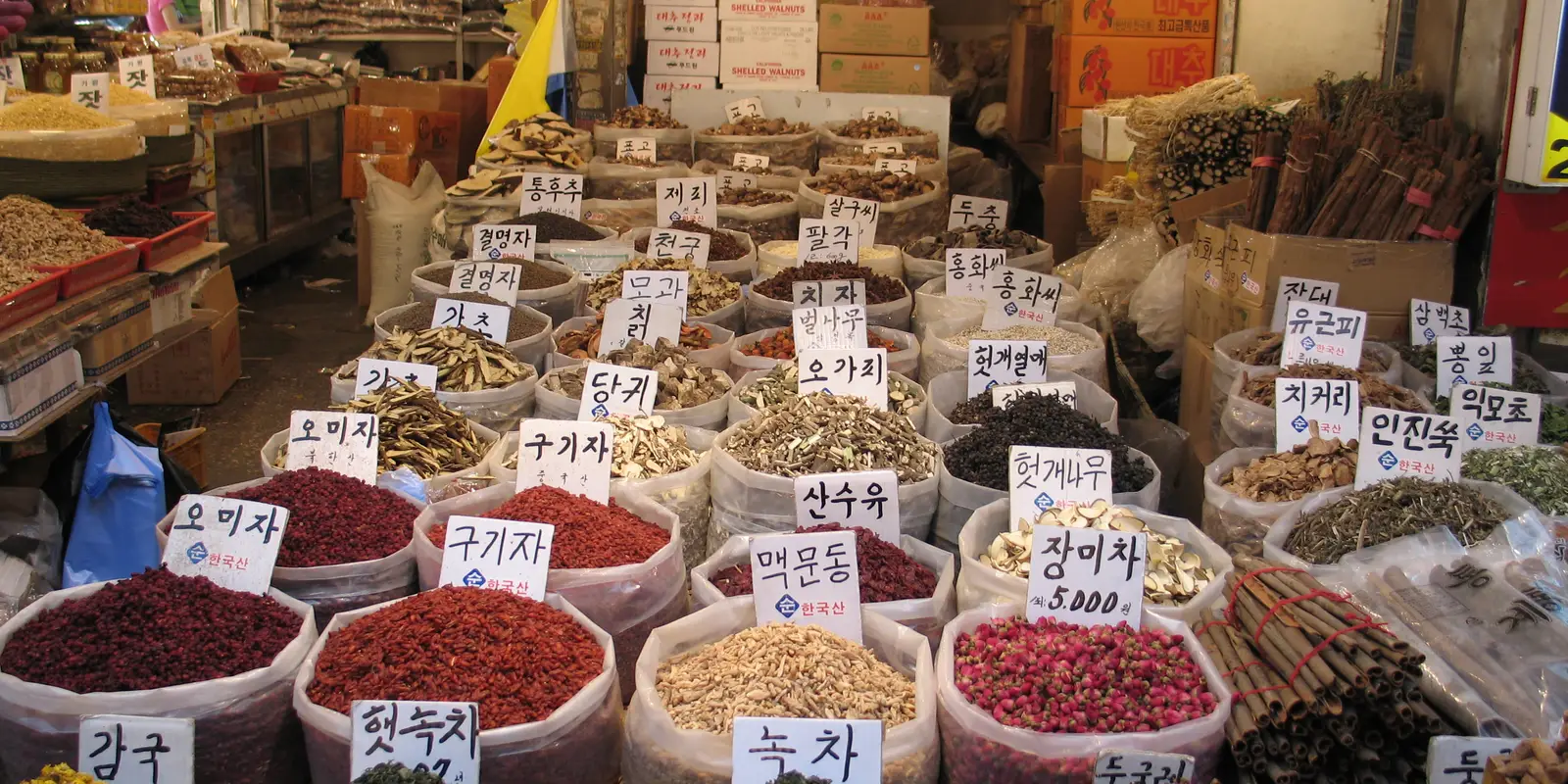
The herbs come in open sacks with the name written on a card, in Korean only in the photo at the top of this page (taken in 2008). These are some of the labels in that photo:
| Label | Said as | What it is |
|---|---|---|
| 오미자 | omija | Dried schisandra berries, red, often made into a sweet-sour tea |
| 구기자 | gugija | Goji berries |
| 산수유 | sansuyu | Dried cornelian cherries |
| 결명자 | gyeolmyeongja | Cassia seeds, roasted for tea |
| 맥문동 | maekmundong | Dried lilyturf root |
| 감국 | gamguk | Small dried wild chrysanthemum flowers, used for tea |
Do the market's stalls keep fixed hours, Sundays included?
There is no single timetable: KTO's VisitKorea page gives both the opening hours and the closing days as "varies by store", and none of the official pages we checked names a market-wide closing day, Sunday included. As a rough frame, citizen reporters on the Seoul city news site gave 08:30–18:00 for Gyeongdong Market, weekends included, and 09:00–18:00 for Seoul Yangnyeongsi in 2023.
That gap decides the order of the visit. The stalls wind down around 18:00 and the café stays open until 22:00, so shop first and finish upstairs.
Can you pay by card at Gyeongdong Market, or do you need cash?
At Starbucks you pay at the counter by card; at the stalls, carry some Korean won in small notes, because no official source lists which shops take cards.
The market has signed up to change that. On 14 May 2026 the Ministry of Culture, Sports and Tourism and KTO named Gyeongdong one of 11 "K-Tourism Markets", with two years of support for marketing, tourism content and service improvements. At the signing, the merchants' association heads of all 11 markets pledged four service standards, according to Newsis's report that day: posted fixed prices, welcoming card payment, cleanliness and hygiene, and friendly service. A pledge by the association still leaves each stall to decide what it accepts.
The Seoul city news site named Zero Pay (제로페이) as a convenient way to pay at Gyeongdong in 2023, and a Zero Pay QR code is not only for Korean apps. The Seoul city government announced in November 2020 that WeChat Pay works at Zero Pay merchants in Seoul. On 1 September 2023 the Korea Easy Payment Foundation, which runs Zero Pay, opened Alipay and Alipay+, and the Korean outlet Smart Today reported that day that visitors from Thailand, Malaysia and Singapore could now pay by Zero Pay QR, as well as those from China, Hong Kong and Macau. We couldn't find a list of which Gyeongdong stalls show the code. To ask about cards, "카드 돼요?" (kadeu dwaeyo?) means "Do you take cards?"
How do you fit the market and the café into one visit?
Arrive between late morning and mid-afternoon, walk the ginseng arcade and the herb sacks while the shops are open, then climb to the café to finish the visit. An hour in the market and another in the café covers both at an easy pace. Add Gwangjang Market, four stops away, only if you start early, because its main market also closes at 18:00.
Three tiers up from the bar, a paper bag of omija from the stalls below sits on the bench beside you when the wall lights up and your order number starts rolling upward like the end credits of a film. Downstairs the stalls are winding down for the day. Up here the café keeps going until 22:00, so there is no hurry to take the steps down to the bar.
Sort your data out before you fly
You keep your SIM and add one data line. Your home number stays on your usual SIM; whether its calls and texts reach you abroad depends on your home carrier's roaming.
See eSIMs by country