20 October at Seoraksan, 4 November at Naejangsan: Korea's 2026 autumn foliage forecast and getting there from Seoul
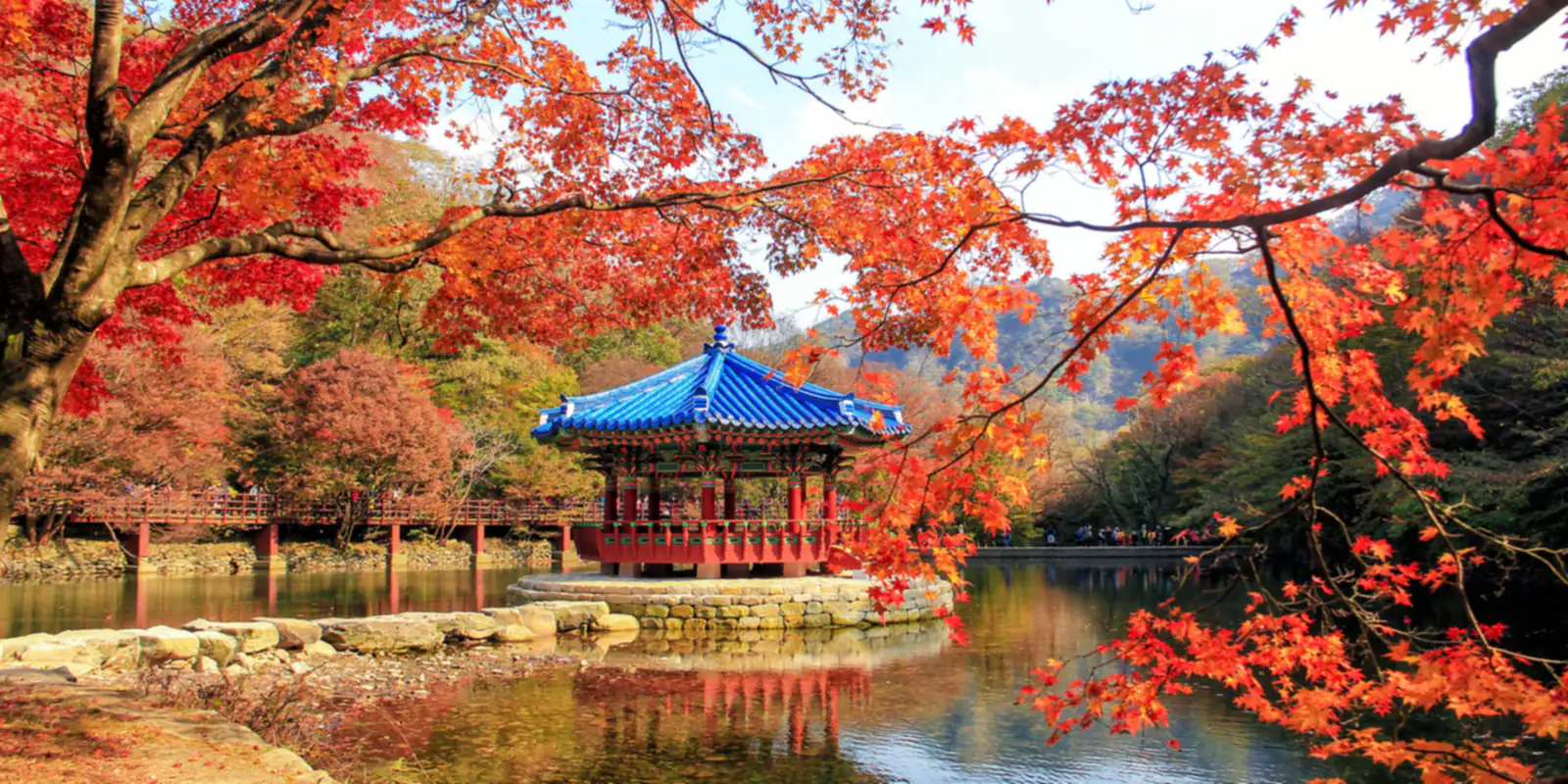
If your trip falls in the last third of October 2026, go to Seoraksan; if it falls in the first days of November, go to Naejangsan. The Korea Forest Service forecast, published on 22 September 2026, puts peak colour at Seoraksan on 20 October and at Naejangsan on 4 November. Seoraksan, on the east coast near Sokcho, is about two and a half hours from Seoul by express bus. Naejangsan, in North Jeolla, is about an hour and forty minutes by KTX plus a local bus. The forecasts, timetables, fares and park rules below come from the Korea Forest Service, the Korea Meteorological Administration, the Korea National Park Service, Jeongeup City, the Seorak cable car operator and the Korea Tourism Organization (VisitKorea), all checked on 10 October 2026.
At a glance (as of 10 October 2026) Seoraksan peak forecast 20 October · Naejangsan 4 November (Korea Forest Service) Seoraksan: bus to Sokcho, then city bus 7 or 7-1 · Seorak cable car 16,000 won return, tickets sold on the day only Naejangsan: KTX to Jeongeup, then a Naejang-bound city bus · Seoraebong trail needs a booking from 18 October to 16 November
When will the leaves peak at Seoraksan and Naejangsan in 2026?
On 20 October at Seoraksan and 4 November at Naejangsan, according to the Korea Forest Service's 2026 forecast map. The same forecast, released on 22 September 2026, gives 28 October for Songnisan and 6 November for Hallasan on Jeju. It says colour starts in earnest in the mountains of northern Gangwon in early October and reaches its peak across most of the country in late October. Compared with the past five years, the Forest Service says this year's peaks come about 0.8 days later.
The Korea Meteorological Administration (KMA) recorded Seoraksan's first colour on 28 September 2026. Its Gangwon office said that was 4 days earlier than in 2025 (2 October) and the same as the long-term average. It gives no 2026 peak date for Seoraksan. For comparison, it lists the peak as 24 October in 2025 and 17 October on average.
Why do the two agencies' dates differ?
They define "peak" differently. The Korea Forest Service counts a peak when 50% of the leaves have turned. It bases the forecast on plant-phenology records that the National Arboretum has kept with regional public arboretums since 2009, and its first sighting of the year came from a citizen observer on Jeombongsan on 14 September. The KMA watches the whole mountain from a fixed point. It calls "first colour" the day about 20% of the mountain, from the summit down, has turned, and "peak" the day about 80% has. For Seoraksan its fixed point is near the ticket office at Sogongwon, the park's entrance on the Sokcho side.
So the two dates measure different things and need not match. Neither is a promise for a particular valley, and the KMA's own definition counts the colour from the summit down.
Where can you see how far the colour has got before you go?
The KMA posts photos for 21 well-known mountains on its Weather Nuri site from 21 September to 27 November 2026. For each mountain it shows pictures taken before the colour, at first colour and at the peak, placed on a map. Its Gangwon office also runs a foliage and weather service at kma.go.kr/gangwon/maple. It covers trails in Seoraksan, Odaesan, Chiaksan and Taebaeksan and includes live video from the mountains.
For Seoraksan there is one more live view. The Seorak cable car's website links a camera at Gwongeumseong, the cable car's upper station, provided by the Korea National Park Service.
How do you get from Seoul to Seoraksan by public transport?
Take a bus from Seoul to Sokcho, then city bus 7 or 7-1 to Seoraksan Sogongwon. VisitKorea's bus page, updated on 5 June 2026, says both the Seoul Express Bus Terminal (subway lines 3, 7 and 9) and Dong Seoul Terminal (Gangbyeon Station, line 2) serve Sokcho. Express tickets are sold at kobus.co.kr, which has English, Japanese and Chinese pages, and intercity tickets at txbus.t-money.co.kr or bustago.or.kr.
The cable car operator's directions give about 2 hours 30 minutes by express bus and 2 hours 10 minutes by intercity bus, with buses roughly every 30 minutes. In Sokcho, its route for buses 7 and 7-1 starts at the intercity bus terminal and passes the express bus terminal before ending at the Seoraksan car park. VisitKorea's hiking guide, last updated in September 2024, tells hikers to get off at the Seoraksan Sogongwon Park stop and gives the park's address as 1055 Seoraksan-ro.
What does the Seorak cable car cost, and can you book it?
A return ticket costs 16,000 won for anyone from middle-school age up, and you can't book: tickets are sold at the counter on the day only. That is the operator's price list as of 10 October 2026. Children from 37 months to primary-school age pay 12,000 won, and under-36-months ride free. Only return tickets are sold, because there is no hiking trail down from the upper station.
Points from the operator's site:
- Hours change daily. The site posts them at the top of its homepage every day. For Sunday 11 October 2026 it gave 08:00–17:30.
- Tickets can sell out. When we checked on the evening of Saturday 10 October 2026, the site listed that day as sold out.
- Departures run every 10 to 15 minutes, and every 5 minutes when it is busy. The ride takes about 5 minutes each way over 1,128 m of cable, to an upper station at 699 m.
- The last car down sets your limit. If you ride the last car up, the operator says you get only about 20 minutes at Gwongeumseong.
- Discounts are for Korean customers. The fare page says reduced fares apply only to domestic customers (국내인), and that the senior discount is suspended from 19 September to 15 November 2026 anyway.
- Refunds: full until 10 minutes before your boarding time, then 20% is deducted.
Can you drive to Seoraksan Sogongwon in peak season?
You can, but on autumn weekends and holidays cars may be stopped short of the entrance. The cable car has no car park of its own; the operator points drivers to the paid car park run by Sinheungsa temple. On 2 October 2026, the broadcaster MTN reported that Sokcho City would run special traffic measures around Seoraksan from the next day until 8 November, mainly on weekends and public holidays. Under those measures, cars are held back in stages as traffic builds, sent to the free B and C district car parks, and visitors are carried in by free shuttle bus. We could not find Sokcho City's own notice, so the shuttle times, and whether buses 7 and 7-1 are held up by the same controls, are not confirmed.
How do you get from Seoul to Naejangsan?
Take the KTX from Yongsan to Jeongeup, about 1 hour 40 minutes, then a city bus bound for Naejang, about 30 minutes. Those are Jeongeup City's own figures. The city also lists a high-speed train from Suseo in southern Seoul at about 1 hour 30 minutes; it still labels that service SRT. An intercity bus from Seoul's Central City Terminal leaves every hour and takes about 3 hours.
Jeongeup City's directions to its museum, at 370-12 Naejangsan-ro on the road out to the park, name bus 171 and say it runs every 20 to 30 minutes; that page was last updated in August 2024. The city's page on Uhwajeong, the pavilion in the cover photo, calls it the first thing you notice on the way into Naejangsan, standing by a lake where the red leaves reflect in the water. VisitKorea lists admission to the national park as free.
What changes at Naejangsan during the 2026 peak?
Two stretches of road inside the park are closed to cars, and one ridge trail needs a booking. The Naejangsan office of the Korea National Park Service posted a notice on 8 October 2026 about vehicle access in the autumn peak season. Its map marks two closed sections:
- Naejangho car park (the former 4th car park) to Wollyeonggyo bridge: 2.1 km
- Yeonjagyo bridge to the Naejangsan Visitor Center: 2.3 km
The notice as posted is a map and gives no dates.
A separate notice, dated 7 September 2026, sets up a trail booking system from 18 October to 16 November 2026. It covers the 2.8 km from the Seorae visitor support centre over Seoraebong peak to Byeongnyeonam hermitage, with a limit of 520 people a day. Bookings are made online at reservation.knps.or.kr, and walking the section without one can bring a fine. The notice covers that section only.
What is worth checking on your phone on the way?
Mostly two things: whether the cable car is still selling tickets, and whether your bus is on time. The cable car's site gives the day's hours, a waiting-time figure and a sold-out notice, and the KMA's Gangwon service shows the colour on live video.
On a Saturday morning in late October, the express bus comes down into Sokcho. Before it reaches the terminal, you can open the cable car page and see whether tickets are still on sale, then decide between going straight to Sogongwon on bus 7 and walking a valley trail instead. For trains, maps and booking apps, a Kedanto Korea eSIM carries data on SK Telecom and LG U+. It carries data only; no Korean phone number comes with it.
Sort your data out before you fly
You keep your SIM and add one data line. Your home number stays on your usual SIM; whether its calls and texts reach you abroad depends on your home carrier's roaming.
See eSIMs by country