Kakao T, k.ride or Uber: what each taxi app asks of a visitor to Korea, from sign-up to payment
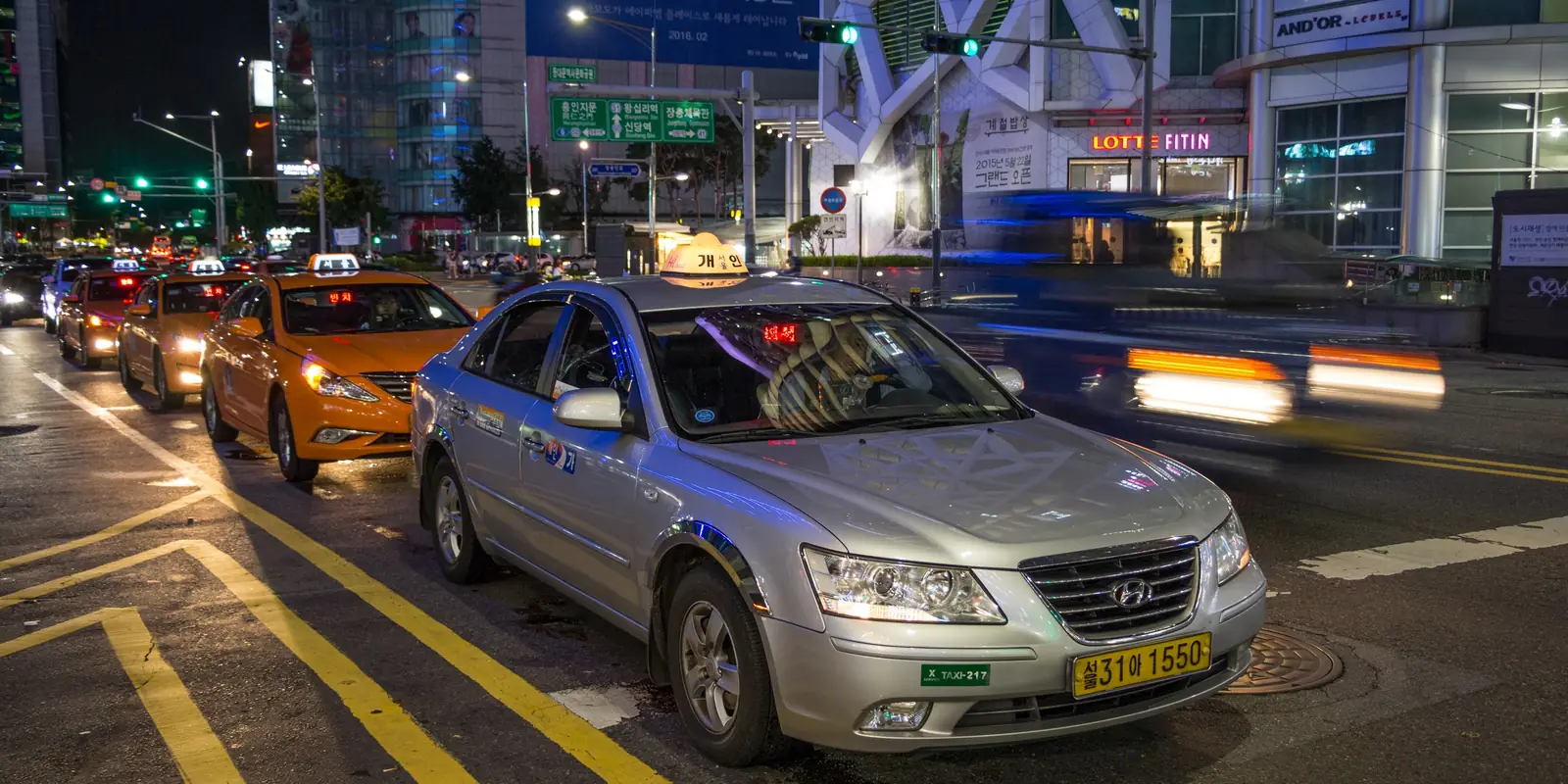
For most visitors the easiest of the three is Uber if you already use it at home, and k.ride if you don't; Kakao T, which Kakao Mobility calls Korea's No. 1 taxi service, takes the most steps on a foreign phone. All three call licensed Korean taxis, and none of them is needed to take one: a taxi hailed on the street or found at a stand takes cash or a card. What follows comes from Kakao Mobility's app listings, terms and own research, Uber's help and city pages, Incheon Airport, the Seoul Metropolitan Government and the Korea Tourism Organization (VisitKorea), all checked on 10 October 2026.
How do Kakao T, k.ride and Uber compare for a visitor?
The differences are in sign-up and payment, not in the taxis. k.ride and Kakao T are both run by Kakao Mobility, and k.ride calls the same Kakao T taxis. Uber matches you with licensed taxis through its own app.
| Kakao T | k.ride | Uber | |
|---|---|---|---|
| Sign-up | Kakao account, text check to your number | Phone number, email, Google or Apple | The account you already have |
| App language | Korean, English, Japanese | English, Japanese, Chinese (simplified and traditional) | Follows your phone; dozens of languages |
| Cards from abroad | Visa, Mastercard, American Express, JCB | Cards, Alipay+, WeChat Pay | The card in your account |
| Pay the driver directly | Yes, cash, card or transport card | No, automatic payment only | Yes, "in-person payment" |
| Extra charges we found | None on the general call (2024 report) | Service fee on every option (2024 report) | 3,000 won on Speed Call, 1,000 won on Green |
The rows are explained one by one below, with the source for each.
Can I sign up for Kakao T with a foreign phone number?
Yes, as long as a text message can reach your home number. In a report on foreign riders, built on data from 7 to 20 December 2023, Kakao Mobility writes that foreigners face no separate restriction when they join Kakao T, and that the app comes in English and Japanese. The same report says joining requires a text-message check of the phone, and that this is where visitors most often got stuck: many travellers' SIMs don't receive texts outside their home country.
The report also shows foreign numbers getting through. Counting riders by the phone number they verified with, Korean +82 numbers were the largest group, then Singapore +65 at 16%, the US and Canada +1 at 13%, Japan +81 at 9% and China +86 at 7%. VisitKorea's ride-hailing guide, last updated in October 2025, adds that Kakao T needs a Kakao account made through KakaoTalk.
So the order is: make the Kakao account and finish the Kakao T text check while you are still at home, or keep your home SIM switched on in Korea so the code can arrive. A Kedanto eSIM can't receive that text, because it has no Korean number and no SMS. How to keep the home line on without paying for its data is in getting verification texts on your home number.
Which cards does Kakao T take?
Visa, Mastercard, American Express and JCB cards issued abroad can be registered for automatic payment, according to Kakao Mobility. Before foreign cards were added, its report says, visitors could not use the auto-pay most Korean riders use and had to pay the driver at the end. With a foreign card registered, the report adds, the premium Venti and Black taxis can also be booked in advance.
You don't have to register a card at all. VisitKorea lists cash, a credit card or a T-money transport card paid to the driver as well as auto-pay. That matters if your bank declines the registration: the taxi still comes, and you settle up in the car.
What does k.ride ask for, and what does it cost?
k.ride signs you up with a phone number, an email address, or a Google or Apple account, and it will not call a car until a payment method is registered. Its terms, published on the k.ride website, say that joining needs "a valid mobile phone number, email, or major SNS account" and that "if the Automatic Payment is not registered, using the k.ride service shall be impossible."
The App Store listing, last updated on 18 September 2026 under the seller name Kakao Mobility Corp., says it takes credit and debit cards plus Alipay+ and WeChat Pay. The Alipay+ wallets it names are Alipay, AlipayHK, Touch 'n Go eWallet, Boost, TrueMoney Wallet, Rabbit LINE Pay and GCash. Kakao said in October 2025 that k.ride calls Kakao T Blue, Venti, Black and deluxe taxis in Korea; the k.ride website shows them as Standard, Comfort, Deluxe and Luxury.
The trade-off is price. When k.ride launched in June 2024, the Korea JoongAng Daily reported that every option carries a service fee and a cancellation charge, and that Kakao T's plain general call, which pays the driver directly, was left out. We found no current fee table from Kakao Mobility, so the app's fare estimate before you confirm is the figure to go by.
Does Uber in Korea work with the account I already have?
Yes. Uber's help centre says the service "is available in any area, regardless of the country automatically set up when you sign up for your profile", so you don't change any settings abroad. The ride options on Uber's Seoul taxi page are all taxis: it lists Uber Taxi, Standard Taxi, Speed Call (3,000 won service fee included), Green (an electric car, 1,000 won included) and Deluxe Taxi, which it describes as a mobeom (deluxe) cab. It also says a Seoul taxi booked through Uber carries up to 4 passengers.
Payment is the flexible part. The same page describes an "in-person payment" option that lets you pay the driver in cash or by card at the end of the ride, or you can use the card stored in your Uber account. Uber's taxi page names Busan, Daegu, Daejeon, Incheon, Seoul and Ulsan as its top Korean cities, with taxi options also listed for Jeju-si, Gyeongju, Bundang in Seongnam, Gangneung, Pyeongtaek and Bucheon.
Which taxi app shows English, Japanese or Chinese?
k.ride covers all three; Kakao T has English and Japanese; Uber follows your phone's language. The App Store lists Kakao T in English, Japanese and Korean, and k.ride in English, Japanese and both forms of Chinese. k.ride's website says destination search and chat with the driver work in 133 languages, with messages translated automatically.
VisitKorea's taxi page, updated on 22 January 2026, says Uber also translates messages with drivers automatically. Kakao Mobility's own report admits a limit on the Kakao side: outside Seoul, many restaurants and cafés have no foreign-language place name, so you may have to search by address.
How do I get a taxi at Incheon Airport, with or without an app?
Without an app, walk to the taxi stands outside arrivals on the 1st floor. Booked cars have their own pickup spots. Incheon Airport's taxi page lists these numbered spots:
- Regular taxis to Seoul: 5C, 6C and 6D at Terminal 1, 7C at Terminal 2. The base fare is 4,800 won.
- Pre-booked taxis: 1C and 14C at Terminal 1, 1C and 10C at Terminal 2.
- International Taxi: 4C at Terminal 1, 3C at Terminal 2. These are Seoul-designated cabs with drivers who speak English, Chinese or Japanese.
The airport also warns that call vans posing as taxis solicit passengers and overcharge, and asks travellers to use the designated stands.
Seoul taxis add a night surcharge of 40% from 23:00 to 02:00 and 20% from 22:00 to 23:00 and from 02:00 to 04:00, according to the same page. For International Taxi, the operator's site lists flat airport-to-Seoul fares by zone, from 70,000 to 95,000 won for a standard car. It asks for bookings at least 24 hours ahead and takes cash or Visa, Mastercard and American Express. On the Uber side, Uber's Incheon page says you can reserve an airport pickup before you land and that there is no separate airport fee. We found no official k.ride page describing an airport booking in Korea.
How do I catch a taxi with no data or no app?
Stand at the roadside and wave at a car showing a red 빈차 sign, or go to a taxi stand. The Seoul Metropolitan Government's taxi guide says 빈차, usually in red, means the cab is free, and 예약, usually in green, means it is already booked. It adds that stands are often near bus stops and that you can pay in cash, by credit card or with a transport card. VisitKorea's taxi page lists the regular base fare as 4,800 won in Seoul, Busan, Incheon, Gyeonggi and Gwangju, 4,500 won in Daegu and Ulsan, and 4,300 won in Daejeon and Jeju.
If you are at a hotel, ask the front desk to call one. The thing that saves the most time is having your destination written in Korean, as an address or a screenshot. If you need an interpreter, the Korea Travel Hotline +82-2-1330 answers in Korean, English, Japanese, Chinese, Russian, Vietnamese, Thai and Indonesian. It is a phone call, though, so it goes over your home line on roaming.
Are there other taxi apps made for visitors?
Two more appear in VisitKorea's ride-hailing guide: TABA and TADA. TABA was built for international tourists with support from the Seoul Metropolitan Government. You sign up with a mobile number or a Google or Apple ID, verify the number, and pay automatically with a registered card. Its App Store listing was last updated in March 2026. TADA accepts an international mobile number at sign-up and a credit card for payment, and it offers advance bookings suited to airport transfers. The guide's version we read was last updated in October 2025.
What works with a home number more broadly, from KakaoTalk to restaurant queues, is covered in what works in Korea without a Korean phone number.
What does a data-only eSIM change for taxi apps?
The ride itself runs on data; the sign-up code runs on your home number. Kedanto's Korea plans are data-only on SK Telecom and LG U+, with no Korean number and no SMS. That covers the map, the car's position on its way to you and the translated chat with the driver. The one-time verification text has to come in on the SIM you brought.
At the end of a long day at a market, both hands are full of bags. The app shows a car three minutes away, and the driver's message pops up already in English. If the phone had no data, you would be out at the kerb looking for a red 빈차 sign instead. Both get you home; the app just lets you wait indoors. The plans are on the Korea page.
Sort your data out before you fly
You keep your SIM and add one data line. Your home number stays on your usual SIM; whether its calls and texts reach you abroad depends on your home carrier's roaming.
See eSIMs by country