If it snows in Seoul, ride the subway: peak service runs 30 minutes longer at a heavy snow advisory and 60 at a warning
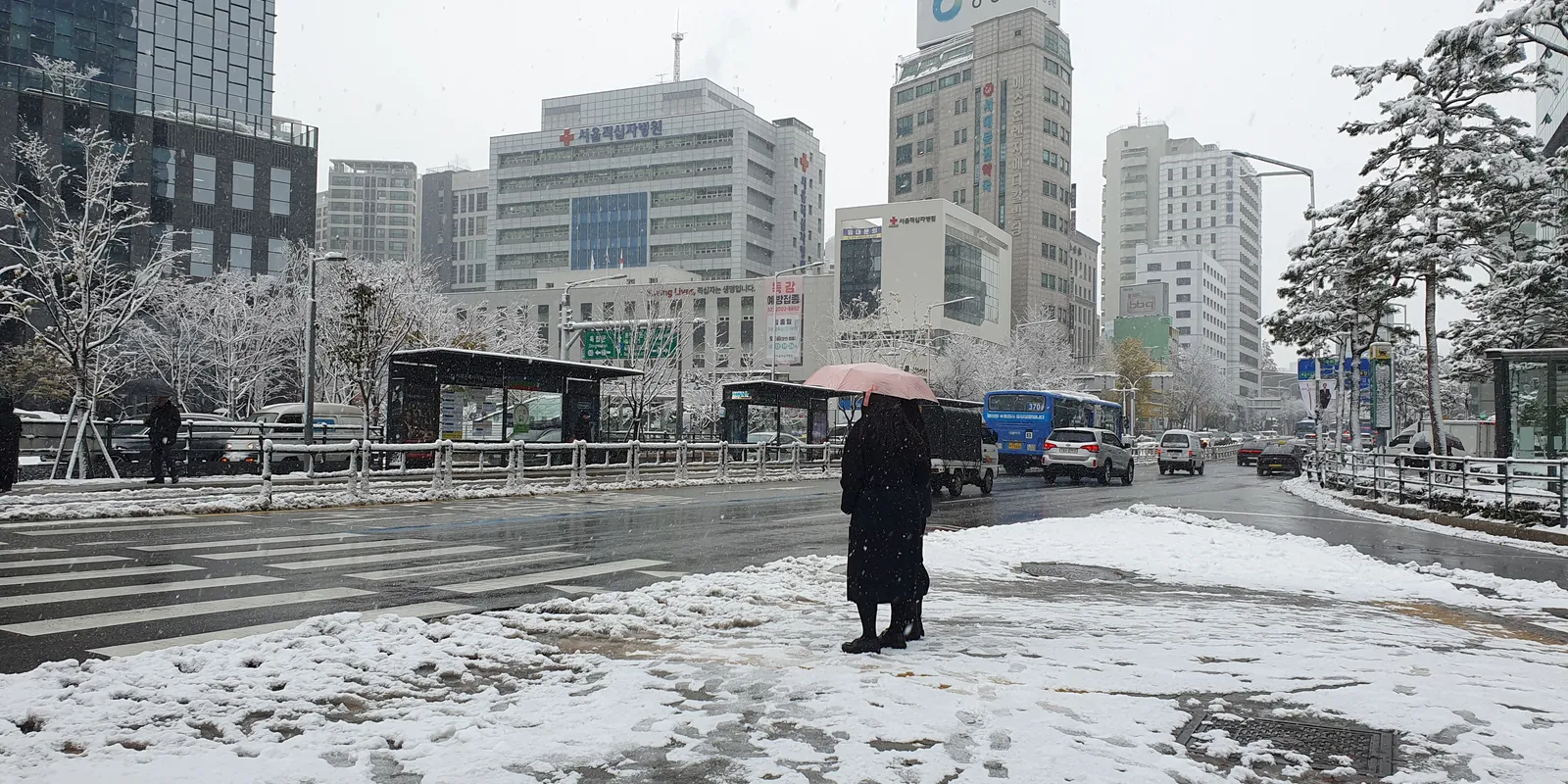
Seoul does not stop for snow, but it changes gear: the city's winter plan is tied to the Korea Meteorological Administration's heavy snow alerts, and at each step it runs more buses and trains for longer. Every source below was read on 7 November 2026 and is named where it is used. The cover photo is the Seodaemun intersection on 27 November 2024, Seoul's heaviest November snowfall since modern records began in 1907.
Why is the subway the steadier choice when Seoul snows?
Because the city's snow plan sends its extra service to the subway and the buses, and the trains do not share the road with the snow. Ahead of snow forecast for the night of 1 to 2 February 2026, the city announced that Lines 2 and 5 to 8 would keep morning peak frequency until 09:30 instead of 09:00 with 20 extra trains, that city buses would hold minimum intervals until 09:30, and that it would act against slips at station entrances and bus stops (city announcement reported by Newsis, 1 February 2026).
Steadier is not immune: The Korea Times reported on 22 February 2024 that Line 5 ran about 25 minutes late after ice formed on the tracks at the Godeok depot in a 13.8 cm snowfall. Delays by line are posted in Seoul Metro's own app, 또타지하철 (TTOTA Subway), in Korean, English, Chinese or Japanese by the phone's language setting since a May 2026 revamp (The Korea Herald, 19 May 2026).
What does Seoul do once a heavy snow advisory or warning is out?
It raises its snow response a stage, and each stage adds time to peak bus and subway service: 30 minutes at Stage 2, 60 minutes at Stage 3. That is one sentence of Seoul's 2025 winter plan, posted on the city's site on 13 November 2025 for 15 November 2025 to 15 March 2026: at snow response Stage 2, declared for a heavy snow advisory and the like, the morning and evening peak dispatch windows for buses and the subway run 30 minutes longer than normal; at Stage 3, for a heavy snow warning and the like, 60 minutes longer. The plan's table defines Stage 2 as a KMA heavy snow or cold wave advisory or a forecast of 5 cm or more, and Stage 3 as a warning or a forecast of 10 cm or more. These are the 2025-26 numbers: as of 7 November 2026 the 2026-27 plan had not been posted.
The plan routes service changes through the 120 Dasan Call Center, the TOPIS traffic site, which has an English version, and the city's transport portal app. At the call center, dial 02-120 and press 9 for English, Chinese, Japanese, Vietnamese or Mongolian, weekdays 09:00 to 18:00 (city notice, 23 September 2026).
How do you read the arrival board at a bus stop?
The board puts the bus that is about to pull in at the top, marked 곧 도착, and shows how many minutes until the one after it. Seoul had 5,816 of these terminals as of 2025 (city page updated 30 May 2025). The city described the layout on 3 December 2020: buses in order of arrival rather than route number, a 저상버스 mark on the 곧 도착 row if that bus is low-floor, its crowding level, and the next bus's minutes beside it. The city's bus.go.kr site shows the same arrival information on a phone before you reach the stop, and on snow days the city has used these boards and the roadside message signs to post road closures and bus detours (city notice, January 2021).
Can you still hail a taxi, and does snow change the fare?
You can, by app or by hand, and the official fare table has no snow surcharge: 4,800 won covers the first 1.6 km, then 100 won per 131 m or, below 15.72 km/h, per 30 seconds. Those are the mid-size rates on Seoul's taxi fare page (last modified 14 October 2026, in force since 1 February 2023). Snow still costs you, because a crawling car is charged on time. The night base is 5,800 won from 22:00 to 23:00 and from 02:00 to 04:00, and 6,700 won from 23:00 to 02:00; leaving the city adds 20%. The International Taxi service on the same page runs fixed fares from Incheon Airport, tolls included, from 70,000 won to Gangseo to 95,000 won to Songpa, Gangdong, Gwangjin, Jungnang, Nowon and Dobong. On cars in snow, the city's winter safety page and KMA's snow guide agree: take public transport.
Where do you check whether a flight out of Incheon is delayed or cancelled?
On the airport's own site, under Flights and then Search Flight, where the Passenger Departure Timetable has a Departure Conditions column and a Last Updated stamp. The English page, read on 7 November 2026, filters by date, time, destination and airline, lists terminal, check-in counter and gate, and tells you to confirm details with your airline because the table changes with airport operations. The customer line is 1577-2600, 07:00 to 22:00, every day. For scale, on the record day of 27 November 2024, Segye Ilbo's early-afternoon report counted 8 cancellations and 75 delays among Incheon's 1,219 flights, and its count as of 18:00 put Incheon cancellations at 71: even then, most flights left, many of them late.
How do you cross a city of ice without falling?
Wide-soled trainers or hiking shoes, hands out of your pockets, the phone put away while you walk, and the handrail on stairs: that is the list on the city's winter safety page, and KMA's heavy snow guide repeats the shoes, the pockets and the public transport. The same city page, written for the 15 November 2025 to 15 March 2026 season, says who clears what: a one-metre strip in front of a house or shop building, the full width of a pavement, within four hours after daytime snow stops, by 11:00 after night snow, or within 24 hours when 10 cm or more falls in a day. What to wear underneath is in Packing for a Seoul winter.
The dry route is underground. Visit Seoul's listing (as of 2025, edited 10 September 2026) gives the Myeongdong Underground Shopping Center as open 09:00 to 22:00 daily, the passage itself 24 hours, from exit 7 of Euljiro 1-ga Station on Line 2. The Euljiro underground passage runs 2.8 km through five stations, City Hall Station to Dongdaemun History and Culture Park Station, the longest in the country by the city's description (Seoul city news, 5 February 2021). The Seoul Facilities Corporation's site, which runs the arcades, would not open for us on 7 November 2026, so Euljiro's hours are unconfirmed here; the subway's own transfer passages need no shop to be open.
What do a KMA heavy snow advisory and warning actually mean?
An advisory means 5 cm or more of new snow is expected within 24 hours; a warning means 20 cm or more, or 30 cm in mountain areas. That is KMA's criteria page; the city's table also lets Stage 3 start at a 10 cm forecast, below KMA's warning line. KMA's Korean site, weather.go.kr, maps the alerts, and its English site has a Current Severe Weather Status page at kma.go.kr/neng/forecast/warning.do. The 16.5 cm of 27 November 2024, a November record since 1907 by KMA's count (The Korea Times), fell short of a warning in central Seoul; that day's warning covered the north-east, where Seongbuk measured 20.6 cm.
Which of the day's snow checks run on data, and which still need a phone number?
All of them run on data except one: the 02-120 operator, who has to be rung. The bus board before you reach it, the delay notice by line, the airport's departure table and the alert map are pages, and pages are what Kedanto's Korea eSIM is for: TOPIS, bus.go.kr, 또타지하철, airport.kr and KMA's site all open on it, over SK Telecom or LG U+, whichever the phone has picked up. No Korean number comes with it, so the call to 02-120 leaves on your home SIM and its roaming. Installed at home, it sits idle until the plane lands; its days are counted from that first Korean connection, and a hotspot lets a companion at the same stop share it.
On a morning when the board shows 곧 도착 for every route but yours, the subway entrance the city has said it will keep safe from slips is its answer, and the arcade door beside it is the dry way to reach it.
Sort your data out before you fly
You keep your SIM and add one data line. Your home number stays on your usual SIM; whether its calls and texts reach you abroad depends on your home carrier's roaming.
See eSIMs by countryRead next
- Packing for a Seoul winter when January mornings average −5.5°C and the subway is heated to 18°C
- Which is cheaper for a few days in Seoul: T-money or the Climate Card?
- Tongin Market's yeopjeon lunchbox: where to buy the coins, the Tuesday closure, and how many to buy
- Seokjojeon at Deoksugung: floors 1 and 2 are reservation-only