Which is cheaper for a few days in Seoul: T-money or the Climate Card?
The Climate Card short-term pass costs less than paying T-money fares once you make about four separate subway or bus journeys inside Seoul in one day on the 1-day pass, or 13 across a week on the 7-day pass (six and 15 if you count the 3,000 won card). Below that, T-money is cheaper. You also need a T-money card anyway for the airport train into Seoul, the Shinbundang Line, taxis and anything outside Seoul. Prices, coverage and refund rules below come from the Seoul Metropolitan Government's Climate Card pages (updated 1 October 2026), Seoul's fare tables, the Korea Tourism Organization (KTO) transport-card page and T-money's own guides, all checked on 10 October 2026.
How much is the Climate Card short-term pass, and when does a day start?
1-day 5,000 won, 2-day 8,000 won, 3-day 10,000 won, 5-day 15,000 won and 7-day 20,000 won, loaded onto a physical card that costs 3,000 won. Seoul describes the Climate Card (기후동행카드) as unlimited subway and bus travel for the period you choose. Its FAQ says the short-term passes are aimed at foreign travelers and short-term visitors, and that discounts don't apply to them, apart from a 13,000 won 7-day pass for teenagers verified on T-money's website.
The pass counts calendar days, not hours. The day you charge it is day one, and Seoul says it can't be charged in advance. Each pass runs from the first train at 04:00 on that day to the last train of its final day, which Seoul puts at around 04:00 the following morning. Night buses between midnight and 04:00 after the final day still accept it, according to the FAQ. A 1-day pass charged at 9 p.m. gives you a few hours, so charge it on the morning of your first busy day.
The card is sold at the newer transit card machines in Seoul Metro stations on Lines 1–8, and at convenience stores around Line 9, Ui-Sinseol Line and Sillim Line stations. Since 17 March 2026, the 440 newer machines at 273 stations on Lines 1–8 accept overseas-issued credit and debit cards such as Visa and Mastercard, plus Kakao Pay and Naver Pay, for buying the card and charging a short-term pass. Seoul's announcement says overseas cards carry a service fee of 3.7% on average.
Older guides also describe a 30-day Climate Card. Seoul ended it on 1 October 2026. The 1- to 7-day passes continue, valid within Seoul.
How many journeys a day before the Climate Card beats T-money?
Four separate journeys on a 1-day pass, seven across a 3-day pass, and 13 across a 7-day pass, counting each journey at the 1,550 won base subway fare. That is the adult fare paid with a transport card such as T-money, in force since 28 June 2025 according to Seoul's fare table. A Seoul city bus costs 1,500 won and a village bus 1,200 won on a card.
The unit that matters is a journey, not a ride. T-money gets the Seoul area's integrated transfer discount: board the next subway or bus within 30 minutes of getting off (60 minutes between 21:00 and 07:00) and it counts as one trip, for up to five rides. You pay the base fare for the first 10 km and 100 won for each further 5 km. A subway-to-bus connection to your hotel is one journey. Heading out again after an hour inside a palace is a new one.
| Pass | Price | T-money journeys that cost more | Counting the 3,000 won card too |
|---|---|---|---|
| 1-day | 5,000 won | 4 (6,200 won) | 6 (9,300 won) |
| 2-day | 8,000 won | 6 (9,300 won) | 8 (12,400 won) |
| 3-day | 10,000 won | 7 (10,850 won) | 9 (13,950 won) |
| 5-day | 15,000 won | 10 (15,500 won) | 12 (18,600 won) |
| 7-day | 20,000 won | 13 (20,150 won) | 15 (23,250 won) |
The last column is the honest one for most visitors. The Climate Card holds no stored value, and Seoul's FAQ says there are no plans yet to add any, so you will usually carry a T-money card as well and the Climate Card's 3,000 won becomes an extra cost.
A worked example: three full days based in Seoul, each one hotel, morning sight, afternoon sight, hotel, all short subway hops. That's 3 journeys a day and 9 in total, or 13,950 won on T-money, against 10,000 won for the 3-day pass, or 13,000 won with its card. The pass comes out 3,950 won ahead, or 950 won if you bought the card only for this trip. Longer rides tilt it further toward the pass, because every 5 km past the first 10 km adds 100 won on T-money and nothing on the Climate Card.
Where does the Climate Card stop working?
At Seoul's boundary on the subway, on the entire Shinbundang Line, and on red regional buses, airport buses, taxis and Ttareungyi bikes. Seoul's page and coverage table give this list from 1 October 2026:
- Covered: subway stations inside Seoul, including the airport railroad (AREX) stations at Seoul Station, Gongdeok, Hongik University, Digital Media City, Magongnaru and Gimpo Airport. Also Seoul-licensed city and village buses, including night and circular buses, which means the blue trunk, green branch and yellow circular buses, even on stretches of route outside Seoul.
- Not covered: the Shinbundang Line, including its Seoul stops such as Sinsa, Gangnam and Yangjae; GTX; subway stations outside Seoul; red regional buses; airport buses; buses licensed by other cities; taxis; Ttareungyi public bikes; and the Han River Bus.
The list shrank on 1 October 2026. Seoul's FAQ says Gimpo, Goyang, Gwacheon, Guri, Seongnam, Hanam and Namyangju dropped out that day, and the station table now marks every Gimpo Goldline station as not covered, the one at Gimpo Airport included. Guides written before October may still say otherwise.
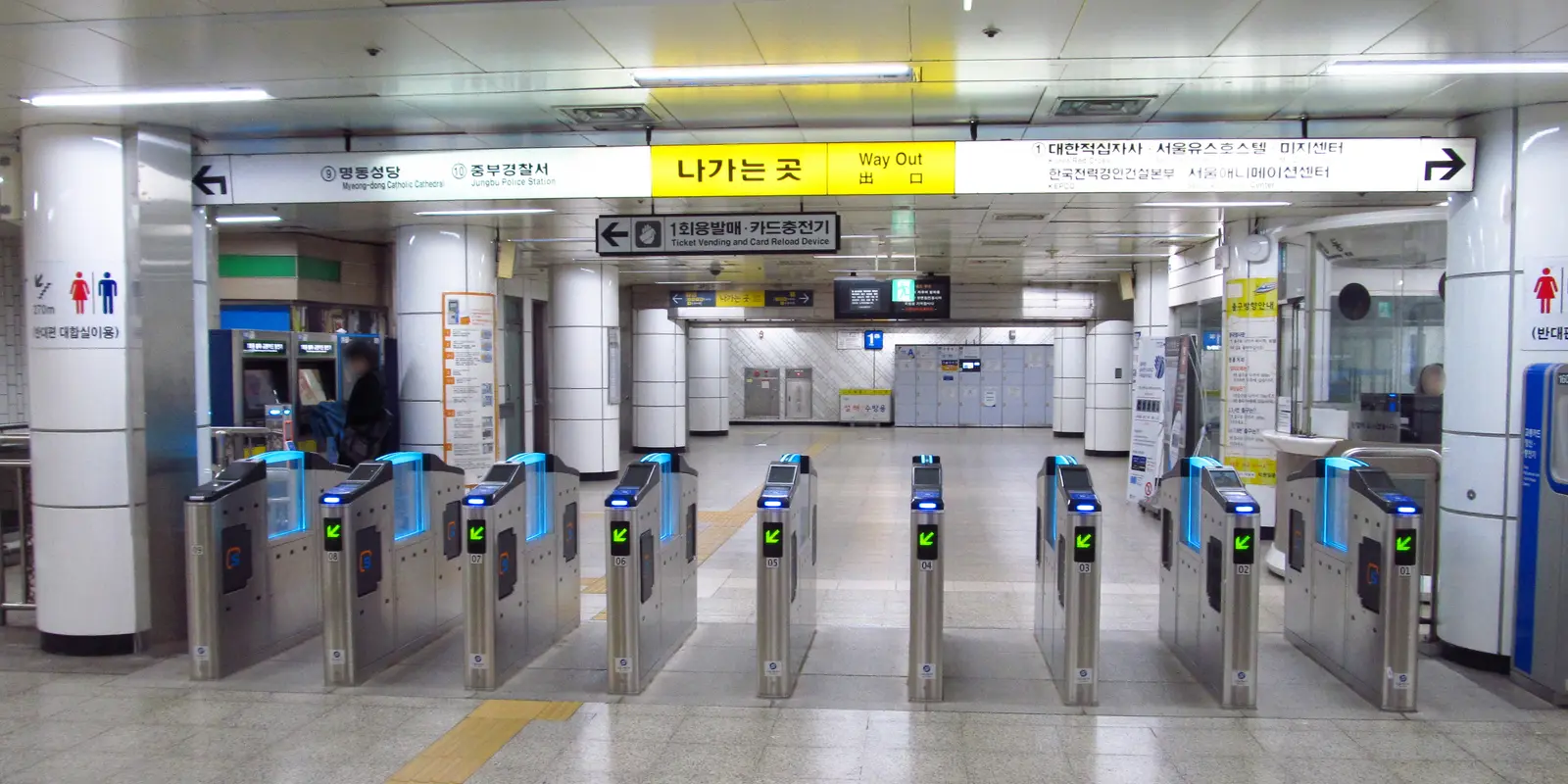
If you board inside Seoul and get off outside it, Seoul says the Climate Card can't be used for that trip, and station staff collect the fare from your boarding station at the exit. The FAQ's example is Seoul Station to Bupyeong Market in Incheon, charged at 1,950 won and paid with an ordinary transport card. At stations shared with the Shinbundang Line, such as Gangnam, Seoul says to use only the gates of the covered line, Line 2.
Can you ride the airport railroad to Incheon Airport on a Climate Card?
Out to the airport, yes. In from the airport, no. Since 1 October 2026, Seoul makes one exception to its Seoul-only rule: you can board at a covered station and get off at Incheon Airport Terminal 1 or Terminal 2 on the airport railroad. Seoul's station table marks both airport stations as "get off: yes, board: no". The table lists AREX stations and doesn't mention the AREX Express train.
That means the pass can cover your last ride out on departure day, as long as that day falls inside the pass. On arrival day it can't help: you can't board with it at the airport, and the card is only sold in Seoul. That first ride is a T-money job, and the first 30 minutes in Korea covers where to buy the card on the arrivals floor and how to top it up.
Can you get unused money back?
From T-money, usually yes. From the Climate Card, only in narrow cases.
T-money's guide (updated 14 September 2026) says the balance left on a T-money card can be refunded at convenience stores and other places, minus a small fee, and that the card's purchase price isn't included. KTO's transport-card page adds that refunds over 50,000 won are handled only at Tmoney Town near Seoul Station Exit 10. Small, frequent top-ups keep the leftover small.
Seoul's formula for the Climate Card is: refund = what you paid for the pass − the fares for the transit you actually used − a 500 won fee. You must apply before the pass expires. For a physical card, Seoul's coverage page says to suspend the card at a station machine before the expiry date and then file the refund on T-money's Card & Pay website within 15 days after it. Seoul's FAQ says short-term passes can be refunded when the card is registered on that website, and that a lost card's remaining days aren't credited. Visitors without a Korean bank account are told to visit T-money's headquarters for a cash refund.
Treat the pass as money spent and pick the length you will use. Registration is where most visitors get stuck, as the next answer explains.
Do you need an app, and when do you need mobile data?
Not to ride. Visitors normally use the plastic Climate Card, and the gate screen shows its expiry date each time you tap. The mobile version runs only on Android phones with OS 12 or later, through the Mobile Tmoney or Samsung Wallet app, and Seoul's FAQ says it can't be issued without identity verification on a phone in your own name. Seoul lists the physical card as the option for iPhone users, and its FAQ says the Climate Card doesn't work with Apple Pay.
Mobile data comes into it at three points:
- Registering the card. The QR code on the back opens T-money's Card & Pay website in your phone's browser. Seoul's FAQ says sign-up there verifies identity through a phone line in your own name or an I-PIN, and an I-PIN requires a Korean foreigner registration number. Where Korean identity checks like this one stop short-term visitors is mapped out in our guide to getting by without a Korean number.
- Checking a bus. Seoul's coverage page says to look up the route number on bus.go.kr (Seoul Bus Information System): trunk, branch, circular and village routes take the card. A map app shows the route type while you wait at the stop, and our map apps guide covers NAVER Map and KakaoMap.
- Checking a station. Seoul's coverage search lists every station with board and get-off marks, which is quicker to look up at the gate than to memorize.
Kedanto's Korea eSIM is a data-only line on the SK Telecom and LG U+ networks, with hotspot allowed, so those look-ups work from the bus stop or the platform. It doesn't come with a Korean number or SMS, so it won't get you through T-money's identity check.
Which card should you buy for your itinerary?
Everyone needs one T-money card. Add a Climate Card only for days spent riding around inside Seoul. Both cards are one per person: Seoul's FAQ says a Climate Card carries one rider at a time, and T-money's guide says the same for a T-money card on the subway.
- Climate Card plus T-money pays off on three or more days based in Seoul with three or more journeys a day, especially long cross-city rides. The 3-, 5- and 7-day passes need fewer journeys per day than the 1-day pass.
- T-money alone is the better fit for an evening arrival, days spent walking one neighborhood, day trips to Suwon or Incheon, or regular rides on the Shinbundang Line between Gangnam and Pangyo.
On the morning you charge the pass, tap through the first gate and read the date on the screen. That is your last day of unlimited rides, and any trip after it goes back on T-money.
Sort your data out before you fly
You keep your SIM and add one data line. Your home number stays on your usual SIM; whether its calls and texts reach you abroad depends on your home carrier's roaming.
See eSIMs by countryRead next
- Tongin Market's yeopjeon lunchbox: where to buy the coins, the Tuesday closure, and how many to buy
- Seokjojeon at Deoksugung: floors 1 and 2 are reservation-only
- Gwangjang Market: hours, the Sunday catch, and why to bring cash
- Transiting through Incheon: whether to turn on a Korea eSIM depends on leaving the airport