Is the National Museum of Korea free? Yes, but 7 rooms are closed until January 2027
The permanent galleries of the National Museum of Korea cost nothing to enter, but until 28 January 2027 seven of its rooms on the second and third floors are closed (five since 6 July 2026, two since 10 August) while the museum refits its Buddhist painting and Buddhist sculpture galleries. The rest of the three floors is open, including the Room of Quiet Contemplation with its two pensive bodhisattvas, and in October 2026 the only exhibition that charges is The Korean Table in Special Exhibition Gallery 2. The hours, closing days, closures, fees, luggage rules and directions below come from the museum's own Korean, English, Japanese and Chinese pages, all checked on 10 October 2026.
At a glance (checked 10 October 2026) Permanent galleries free · The Korean Table 5,000 won for adults, until 25 October Mon, Tue, Thu, Fri, Sun 09:30–17:30 · Wed, Sat 09:30–21:00 · last entry 30 minutes before closing Closed until 28 January 2027: rooms 202-3, 202-4, 203, 204, 301, 302 and the Room of Sense Line 4 or Gyeongui–Jungang Line to Ichon Station, Exit 2, about a 10-minute walk
What costs money at the museum in October 2026?
The permanent exhibition hall, the Children's Museum and the free special exhibitions cost nothing. Only paid special exhibitions charge, and in October 2026 there is one. It is The Korean Table: Food, Nature, and Life (우리들의 밥상) in Special Exhibition Gallery 2, running from 1 July to Sunday 25 October 2026 with about 420 objects, among them a set of vessels excavated from the tomb of King Muryeong of Baekje. The exhibition page lists adults aged 25 to 64 at 5,000 won and visitors aged 7 to 24 at 3,000 won. Children aged 6 and under and visitors aged 65 and over go in free once they show proof of age at the ticket desk. On Wednesdays, the museum's "Culture Day", tickets bought from 6 p.m. are half price, for that day only.
The desk stops selling at 16:50, or 20:20 on Wednesdays and Saturdays, and on the day it sells only same-day tickets. Advance tickets go through Ticketlink and Naver until the day before your visit, up to 10 per person. Special Exhibition Gallery 1 has nothing on: the museum's listing shows its Thai art exhibition closing there on 6 September, and the next show, works from the Kunsthaus Zürich, opening on 27 November 2026.
Three smaller thematic displays sit inside the free permanent galleries: Kim Jeonghui and His Companions in the second-floor Calligraphy and Painting gallery until 22 November, a display of newly donated calligraphy in Room 205 until 15 November, and Evergreen Bamboo Through the Four Seasons Embodied in Ceramics in the third-floor Buncheong Ware and White Porcelain gallery until 31 January 2027.
Which evenings is the museum open until 21:00, and when does it close on other days?
Monday, Tuesday, Thursday, Friday and Sunday 09:30–17:30; Wednesday and Saturday 09:30–21:00. Last entry is 30 minutes before closing, so 17:00 or 20:30, and staff begin guiding visitors out 10 minutes before closing. The outdoor exhibition area and gardens keep separate hours, 07:00 to 22:00.
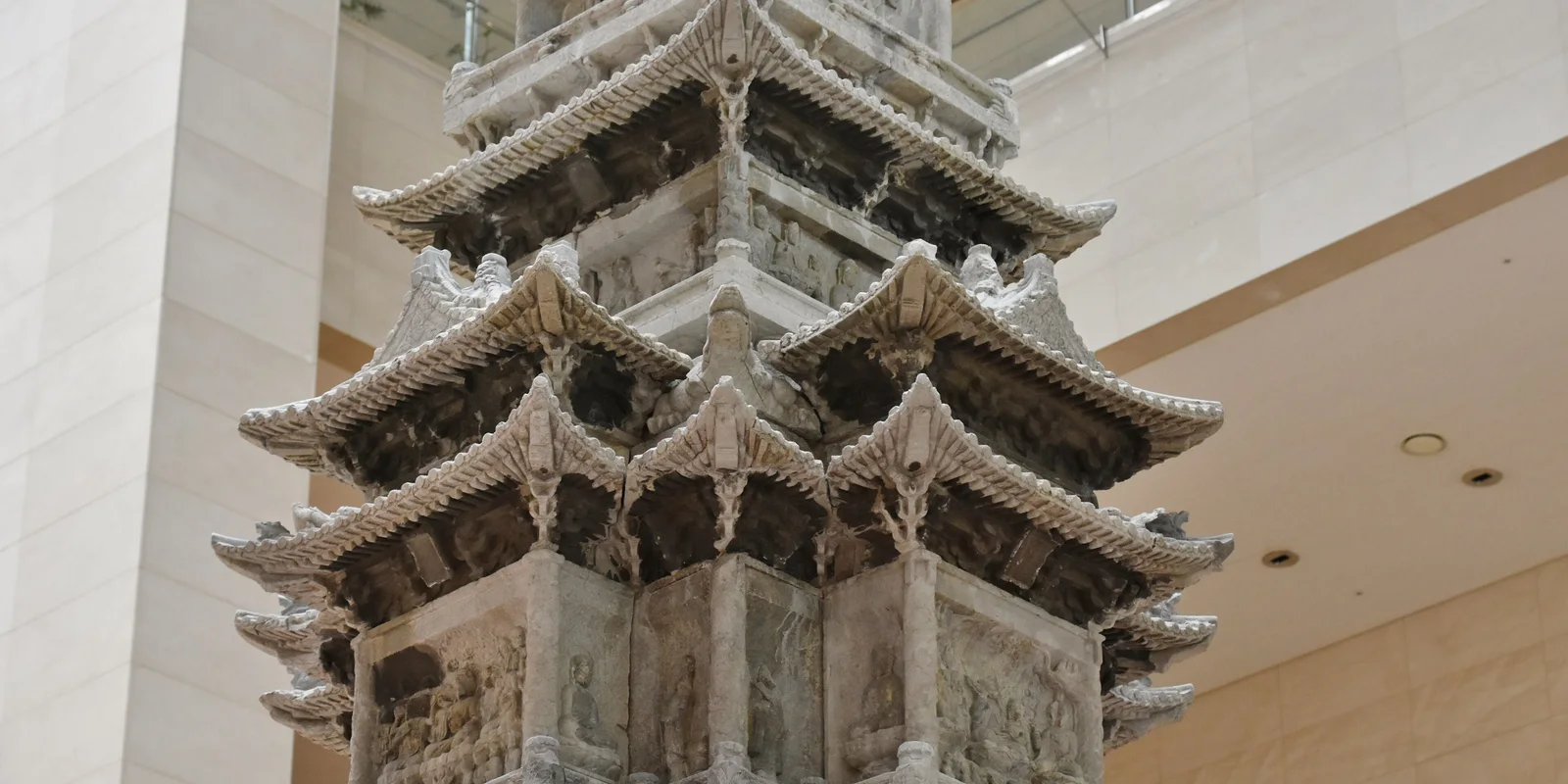
The two late nights have something the daytime doesn't. Every Wednesday and Saturday evening the museum projects a free 12-minute media façade show, Lighting the Sky Pagoda (하늘 빛 탑), onto the Ten-story Stone Pagoda from Gyeongcheonsa Temple on the first floor. The start time is not settled for October. The Korean page lists 20:00 and notes that it can move with sunset, while one of the two schedule tables on the English page gives 19:00 from October to February and 20:00 from March to September. Ask at the information desk, or be at the pagoda before 19:00. Wednesday 21 October is the last Wednesday before The Korean Table closes, so a half-price ticket bought from 18:00 that evening and the pagoda show fit into one cheap evening.
Does the museum ever close in October or November?
Not in October or November 2026. The whole museum closes on only three days a year: 1 January, Seollal (Lunar New Year's Day, 17 February in 2026) and Chuseok (25 September in 2026). Separately, the permanent galleries and Special Exhibition Galleries 1 and 2 close on the first Monday of March, June, September and December, while the outdoor exhibition area stays open. In 2026 those gallery closures fall on 1 June, 7 September and 7 December, with none in March.
So the next closing day of any kind is Monday 7 December 2026, then Friday 1 January 2027. Seoul's main palaces each shut one weekday every week; this museum doesn't.
Which galleries are closed until January 2027?
Seven rooms on the second and third floors, from 6 July 2026 (two of them from 10 August) through Thursday 28 January 2027, reopening on Friday 29 January 2027. The museum's permanent-exhibition page gives the list:
| Floor | Closed | Dates |
|---|---|---|
| 3F | Buddhist Sculpture (301), Metal Crafts (302), the Room of Sense | 6 Jul 2026 – 28 Jan 2027 |
| 2F | Buddhist Painting (203), Wood and Lacquer Crafts (204) | 6 Jul 2026 – 28 Jan 2027 |
| 2F | Calligraphy and Painting (202-3, 202-4) | 10 Aug 2026 – 28 Jan 2027 |
Still open in those two sections: Calligraphy and Painting rooms 202-1 and 202-2, the Celadon gallery (303) and the Buncheong Ware and White Porcelain gallery (304). The first floor, the Room of Quiet Contemplation, the Donated Collection on the second floor and World Art on the third floor are outside the closure. Older guides that send you to the Buddhist sculpture room or the metalwork room on the third floor are describing rooms you can't enter until late January.
How big is the museum, and what can you see in two hours?
Too big to finish in two hours. The permanent exhibition hall alone covers 27,090 square metres on three floors, and the museum's Korean floor guide counts 39 rooms in seven sections showing 9,884 objects, rotated from time to time. Its own highlights tour, run in Korean several times a day, takes about an hour and stops at around a dozen objects. A two-hour visit built on that tour's stops, with the closed rooms taken out:
- First floor, Path to History, 15 minutes. The Ten-story Stone Pagoda from Gyeongcheonsa Temple, a National Treasure, stands in the long central corridor that links the galleries on all three floors.
- First floor, Prehistory and Ancient History, 40 minutes. Walk the rooms in order from the Paleolithic hand axe in Room 101 through the Neolithic comb-pattern pottery and the Goguryeo room to the Silla room, where the tour's stop is a gold crown and gold belt.
- Third floor, Celadon (303) and Buncheong Ware and White Porcelain (304), 30 minutes. The tour picks a Goryeo celadon incense burner and a Joseon white porcelain moon jar. Room 304 also has the bamboo display until 31 January 2027.
- Second floor, Room of Quiet Contemplation, 20 minutes. The museum's tour also ends here, at the entrance.
- About 15 minutes for the locker, the bag check at the entrance and the escalators between floors.
The museum adds that the tour's objects can change with what is on display, so treat the named pieces as likely rather than certain.
Why save the Room of Quiet Contemplation for last?
Because it is a silent room on the second floor, built for two gilt-bronze pensive bodhisattvas, both National Treasures, made in the late 6th and early 7th centuries and shown side by side. You reach them along a dark, quiet corridor. Each figure sits with the right leg crossed over the left knee and the fingertips of the right hand resting lightly against the cheek, a pose the museum reads as deep thought about birth, ageing, illness and death. The museum asks everyone inside to stay silent, guided groups included, which makes it an easy room to end on after an hour and a half of louder rooms.
Where does a backpack or suitcase go while you look round?
Into a locker or the cloakroom, not the galleries. The museum asks visitors to put backpacks in the first-floor lockers, and its banned-items list for the permanent exhibition hall, dated December 2025, includes luggage larger than 55 × 40 × 20 cm (over 20 inches). The same list bars outside food and drink apart from capped bottled water, baby food and medicine, and it bars selfie sticks, gimbals, tripods and filming lights. Flash photography is not allowed either. Bags have gone through a security check at the entrance since 11 June 2024.
The list tells visitors to leave banned items at the cloakroom or outside the building. The museum's Japanese- and Chinese-language visitor pages put the cloakroom on the left side of the main hall of the permanent exhibition building, and the English page describes free coat storage on the west side of the main entrance. The Chinese page lists lockers along the corridor leading to the cloakroom, inside Special Exhibition Gallery 1 and in front of the Children's Museum. The Japanese page describes the ones in the gallery and at the Children's Museum as coin lockers that take a 100-won coin and return it, so carry one. No page gives a size limit for the cloakroom, so a large case on an airport day is safer left at your hotel.
How long is the walk from Ichon Station, and is it under cover?
About 10 minutes by the museum's estimate, and part of it runs through an underground walkway: take Line 4 or the Gyeongui–Jungang Line to Ichon Station (이촌역) and leave by Exit 2. In the Exit 2 direction, an underground walkway called the Museum Nadeulgil (박물관 나들길) leads to the museum's West Gate. It runs 255 metres in total: a 160-metre straight section with a moving walkway, then 95 metres inside the museum grounds. It opens 07:00–23:00, two hours past the 21:00 closing on Wednesdays and Saturdays, and stays shut on the museum's closing days. Lifts are on the Exit 1 side and at the Nadeulgil entrance toward Exit 2.
From elsewhere, the museum suggests changing to Line 4 at Samgakji (Line 6), Chongshin Univ. (Isu) (Line 7) or Dongjak (Line 9), or to the Gyeongui–Jungang Line at Yongsan (Line 1) or Oksu (Line 3). City buses 400 and 502 stop at National Museum of Korea, Yongsan Family Park. The street address is 137 Seobinggo-ro, Yongsan-gu. Which card to tap at the gates is covered in T-money or the Climate Card, and the route from your hotel in our map apps guide.
Does the museum explain its galleries in your language?
Yes. A free one-hour tour for foreign visitors runs twice a day, and the museum's free apps narrate exhibits in English, Japanese, Chinese, Vietnamese and Korean. The tour meets at 10:30 and 13:00 in front of the Korean Empire room on the first floor of the permanent exhibition hall. On Sundays the museum splits the languages: English and Japanese at 10:30 and 13:00, Chinese at 13:00 only. For Monday to Saturday it lists the same two times and the three languages without saying which language runs at which time, and it changes the schedule every month. Korean nationals can join only when accompanying a foreign visitor. The museum's directions page lists phone lines by language: +82-2-2077-9046 for Korean and English, +82-2-2077-9085 for Japanese and +82-2-2077-9045 for Chinese.
There are two apps, both free on Google Play, the App Store and One Store. National Museum of Korea Exhibition Guide adds augmented-reality navigation and AR content in Korean and English. The National Museums App covers all 14 national museums. Bluetooth beacons in the galleries trigger commentary as you approach an exhibit, so location and Bluetooth must be switched on, and the museum lists Android 7.0 or iOS 14.0 and later. Bring your own earphones. A guide robot called QI also answers in English, Chinese and Japanese on the first-floor Path to History and in the second-floor Donated Collection, from 09:30 until 30 minutes before closing.
The museum recommends downloading the apps' content over Wi-Fi before you visit. If you arrive without it, the download happens in the hall on whatever connection your phone has, and so does scanning the QR code on the museum's smart kiosks, which opens a chatbot guide on your phone. A Kedanto Korea eSIM turns that into an ordinary mobile download over SK Telecom or LG U+, and a companion fetching the same guide can ride on your connection through the hotspot. Being a data plan and nothing else, it comes without a Korean phone number or any way to receive SMS.
At 19:40 on a Saturday the third floor has just over an hour left. Walk toward the bamboo-patterned ceramics in Room 304 with the guide app open, and if the app covers that piece, its beacon picks up your phone and the commentary starts in your earphones without a tap, from content you downloaded before coming in. The doors close at 21:00, so there is time for the rest of the room.
Sort your data out before you fly
You keep your SIM and add one data line. Your home number stays on your usual SIM; whether its calls and texts reach you abroad depends on your home carrier's roaming.
See eSIMs by countryRead next
- Seoul's free Wi-Fi covers markets, parks and buses, not the walk between them
- Which is cheaper for a few days in Seoul: T-money or the Climate Card?
- Tongin Market's yeopjeon lunchbox: where to buy the coins, the Tuesday closure, and how many to buy
- Seokjojeon at Deoksugung: floors 1 and 2 are reservation-only