The loud alert that just went off on your phone in Korea came from the nearest mast, and its one English word names the hazard
The siren-like tone was a 재난문자, a disaster alert that the mast your phone is on broadcast to every handset in range, and if it was loud enough to make you jump it was one of the two levels that also carry an English word for the hazard. Korea sends these by cell broadcast, which is why a phone that has never had a Korean number can get one, and why the text is in Korean. Everything below is from the Ministry of the Interior and Safety, the Korea Meteorological Administration, the police, the Korea Tourism Organization, Apple and Samsung, read on 7 November 2026; calling for help is covered in calling 112 or 119 on a data-only eSIM.
Why did a phone with no Korean number receive a Korean government message?
Because it is not a message to you; it is a broadcast from the mast. The ministry's rule, 재난문자방송 기준 및 운영규정, defines the service as text "sent in broadcast fashion to an unspecified number of people" to phones with the CBS (Cell Broadcasting Service) function; the KMA's earthquake-alert rule (in force since 28 May 2026) adds that the phone takes whatever the base station sends on its receiving channel. Nothing is addressed to a number; the police say their missing-person alerts, sent the same way, collect no personal information. The limit is the handset: Samsung's FAQ sends 3G phones and 4G phones released in 2012 or earlier to the 안전디딤돌 app instead, and Apple's page of 12 December 2025 requires "a SIM card or eSIM from a supported carrier".
Which of the three levels did you just hear?
The loud one was 위급재난문자 or 긴급재난문자; the one that sounded like an ordinary text was 안전안내문자. The rule's table:
| Level | Used for | Sound | Can be switched off |
|---|---|---|---|
| 위급재난문자 (critical) | Large-scale disasters and risk to life, to be received without exception | Maximum volume, at least 40 dB | No |
| 긴급재난문자 (emergency) | Terrorism, an expected radioactive leak, an evacuation order, KMA extreme rain, severe flood information, a landslide warning | Maximum volume, at least 40 dB | Yes |
| 안전안내문자 (safety advisory) | Early-evacuation advice, the lifting of an order, every other weather warning or advisory | Your normal text sound | Yes |
The ministry's press release of 26 February 2026 adds that any evacuation must go out as 위급 or 긴급, "a beep of 40 dB or more" at maximum volume, and opens the critical level to local governments for large-scale disasters.
Is the alert only in Korean?
The loud levels carry the hazard type in English; the quiet level is not covered by that rule. On 28 February 2024 the ministry and the KMA announced that alerts with an alarm sound, 위급 and 긴급, would show the disaster type and any earthquake magnitude in English beside the Korean: Earthquake, Heavy rain, Hazmat for a suspected terror attack, M for magnitude. The word says what the hazard is, not how serious the alert is; the level is what the sound already told you. The announcement says nothing about 안전안내문자, so expect those in Korean, and longer: the loud levels stay within 90 characters, advisories have a 157-character version in use nationwide since 15 May 2026, so a long, quiet Korean message is almost always an advisory.
Where does the whole text come in English, Japanese or Chinese?
In the ministry's Emergency Ready App, and by voice on 1330. The Ministry of the Interior and Safety's app went from three languages to 22 in June 2026 and is, in the ministry's words of 8 October 2026, for "foreign residents and visitors"; its alerts are app notifications over the internet, a translation, not the broadcast, so allow notifications and location when it asks (the ministry's install note of 15 June 2026). It also lists nearby shelters and public medical facilities. 1330, the Korea Tourism Organization's helpline, interprets and answers travel questions but is not for emergencies (VisitKorea's FAQ sends those to 112, 119 or 1339); the KTO lists it as open 24 hours a day in eight languages, Russian, Vietnamese, Thai and Malay/Indonesian from 08:00 to 19:00, with chat on the web (no download) or through KakaoTalk, LINE, Facebook Messenger and WhatsApp, and +82-2-1330 from abroad.
Does a data-only eSIM receive the broadcast, and what does it need data for?
No official page promises it either way, so take the app as the reliable route and the eSIM as what carries it. By the rule the alert is a broadcast from the base station to every CBS-capable handset in its cell; whether a handset shows it is decided by the handset and its carrier settings, as Apple and Samsung both put it above. No official page says in so many words whether a visitor's data-only travel eSIM or a roaming line displays Korean alerts, so this post makes no promise. Kedanto's Korea eSIM has no Korean number and moves data alone, which happens to be everything that follows the beep: the app's translated notification, the shelter list, the 1330 chat. With the home SIM's roaming data off, those travel on the eSIM or not at all. It can go onto the phone days ahead; the countdown on it begins only with the phone's first connection in Korea.
Which alerts arrive in a Korean winter, and at what hours?
Cold-wave warnings by day, snow alerts around the commute, fire and missing-person notices whenever they happen. The rule's schedule for the ministry's own weather alerts:
- 한파 (cold wave): the warning level only, and only between 06:00 and 21:00; none overnight, none for an advisory, though a city may add its own. Among the KMA's conditions for the warning is a forecast morning low of −15°C or below for two days or more; for the advisory, −12°C.
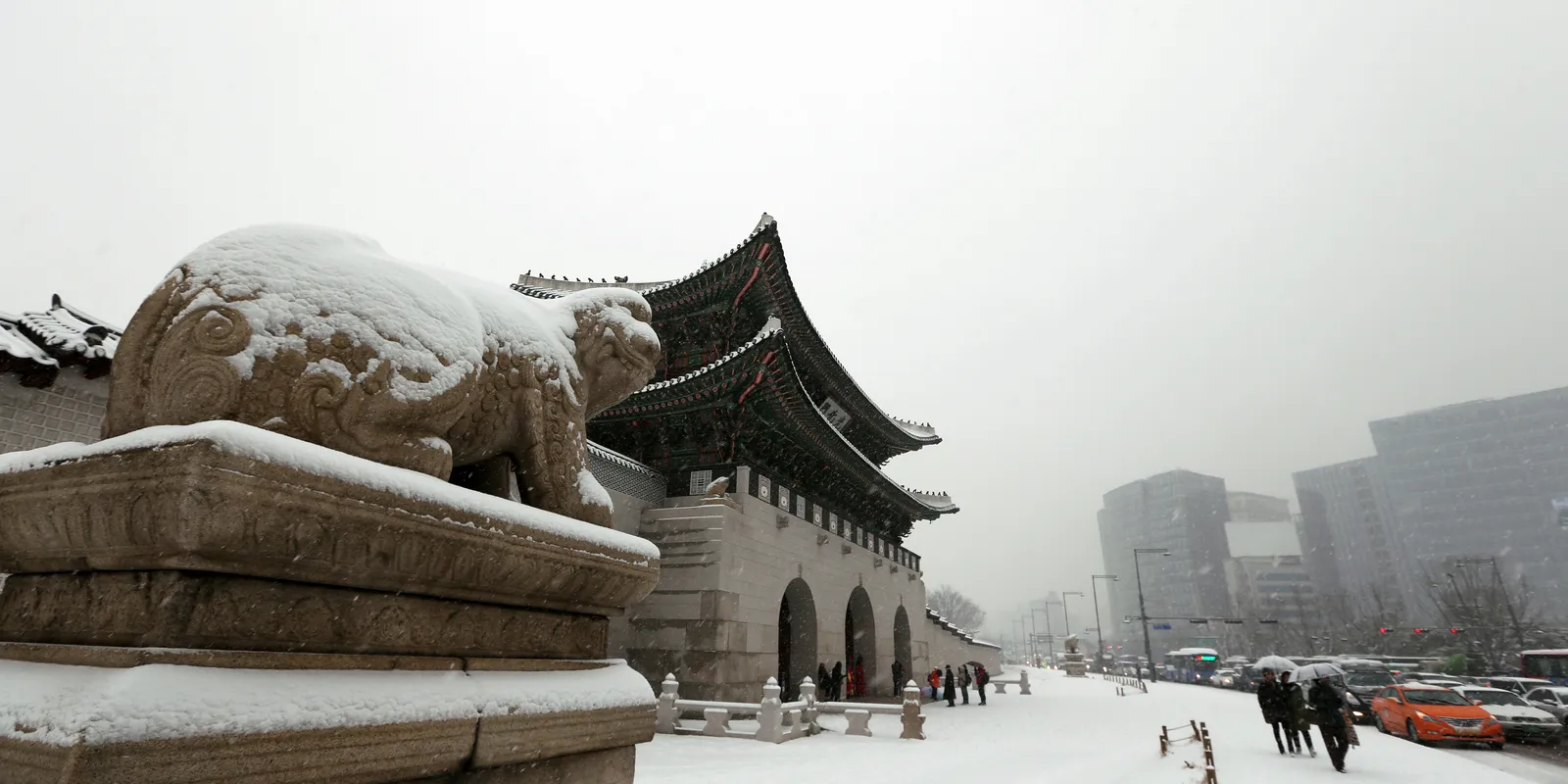
- 대설 (heavy snow): advisory and warning during the weekday commute windows, from 06:00 to 10:00 and from 16:00 to 21:00; at other hours, the warning only. A KMA advisory means 5 cm or more of snow in 24 hours, a warning 20 cm, or 30 cm in mountain areas.
- 화재 (fire): fire is on the rule's list of social disasters; since 16 August 2017 the 17 regional governments have approved and sent such local alerts at their own judgment.
- 실종 (missing person): sent by the police since 9 June 2021 over the same cell broadcast, for children under 18, people with intellectual, autism-spectrum or mental disabilities, and people with dementia, with a link to a photo; the government's sample of December 2021 is labelled 안전안내문자 and shows the police number 182.
Packing for a Seoul winter has the temperatures these thresholds sit against.
Is muting allowed, and which level stays on no matter what?
The advisory and emergency levels can be switched off in the phone's settings; the critical level cannot, by rule. On an iPhone: Settings, Notifications, then the Government Alerts switches at the bottom, with Apple's note that some countries or regions do not allow them off. On a Galaxy, Samsung's FAQ of 31 January 2022 gives Messages, 안전 안내 문자, Settings (Android 11 and 12), with separate switches for 긴급 재난 문자 and 안전 안내 문자; they cannot be muted on their own, vibrate leaves them ringing, and only silent mode quiets them, along with everything else. Keep 긴급재난문자 (evacuation orders, the English word); 안전안내문자 is where the cold-wave and snow warnings arrive by rule, and where the police's sample missing-person alert sits, so switching it off trades exactly that winter information for quiet. The app's notifications are separate from those switches, so advisories off on the phone and the app on is a workable split.
What do you do in the first minute after the loud one?
Read the English word, then look for 대피, the Korean for evacuate, and a district name. If the message contains 대피명령, an evacuation order, follow the people around you to the nearest marked shelter; a korea.kr policy-reporter explainer of 13 June 2023 says that if you do not know one, head for the nearest underground facility with a shelter sign, a subway station, underground car park or large basement, and that the National Disaster and Safety Portal (safekorea.go.kr) lists each shelter's location, size and capacity, as does the app. If the word is Heavy rain or Earthquake and nothing orders you out, the alert means stay clear: off riverside paths, away from steep slopes, indoors.
The practical question this leaves is not about the phone, and it is better answered in a warm hotel room than in the street after the beep: where is the nearest shelter to the place you are sleeping tonight?
Sort your data out before you fly
You keep your SIM and add one data line. Your home number stays on your usual SIM; whether its calls and texts reach you abroad depends on your home carrier's roaming.
See eSIMs by country