Seollal closes Korea's banks and department stores but keeps its palaces open
Seollal, the Lunar New Year, is a four-day public holiday in 2027, from Saturday 6 to Tuesday 9 February, and on those days the royal palaces stay open by rule while the banks, the department stores and many small restaurants close. Seollal itself is Sunday 7 February 2027, which is why the Korea Astronomy and Space Science Institute (KASI) lists a substitute holiday on the Tuesday. Beyond the dates nothing is fixed by law, so this guide uses each institution's own rules and what it did over the 2026 holiday, 16 to 18 February 2026, all checked on 7 November 2026.
Which days are public holidays for Seollal 2027, and is the Friday before one?
Saturday 6, Sunday 7, Monday 8 and Tuesday 9 February 2027; Friday 5 February is an ordinary working day. KASI's calendar data for 2027, generated on 30 June 2026, and the 2027 calendar essentials the Korea Aerospace Administration announced the day before (Segye Ilbo, 29 June 2026) agree: Seollal is 6 to 8 February, Saturday to Monday, and the substitute holiday for Seollal is Tuesday 9 February. Korea's holiday regulation makes the eve, the day and the day after public holidays and adds a substitute weekday only when one of the three falls on a Sunday or another public holiday, not a Saturday, which is why this Saturday-to-Monday holiday gains one day rather than two.
Are the palaces open, and do they charge?
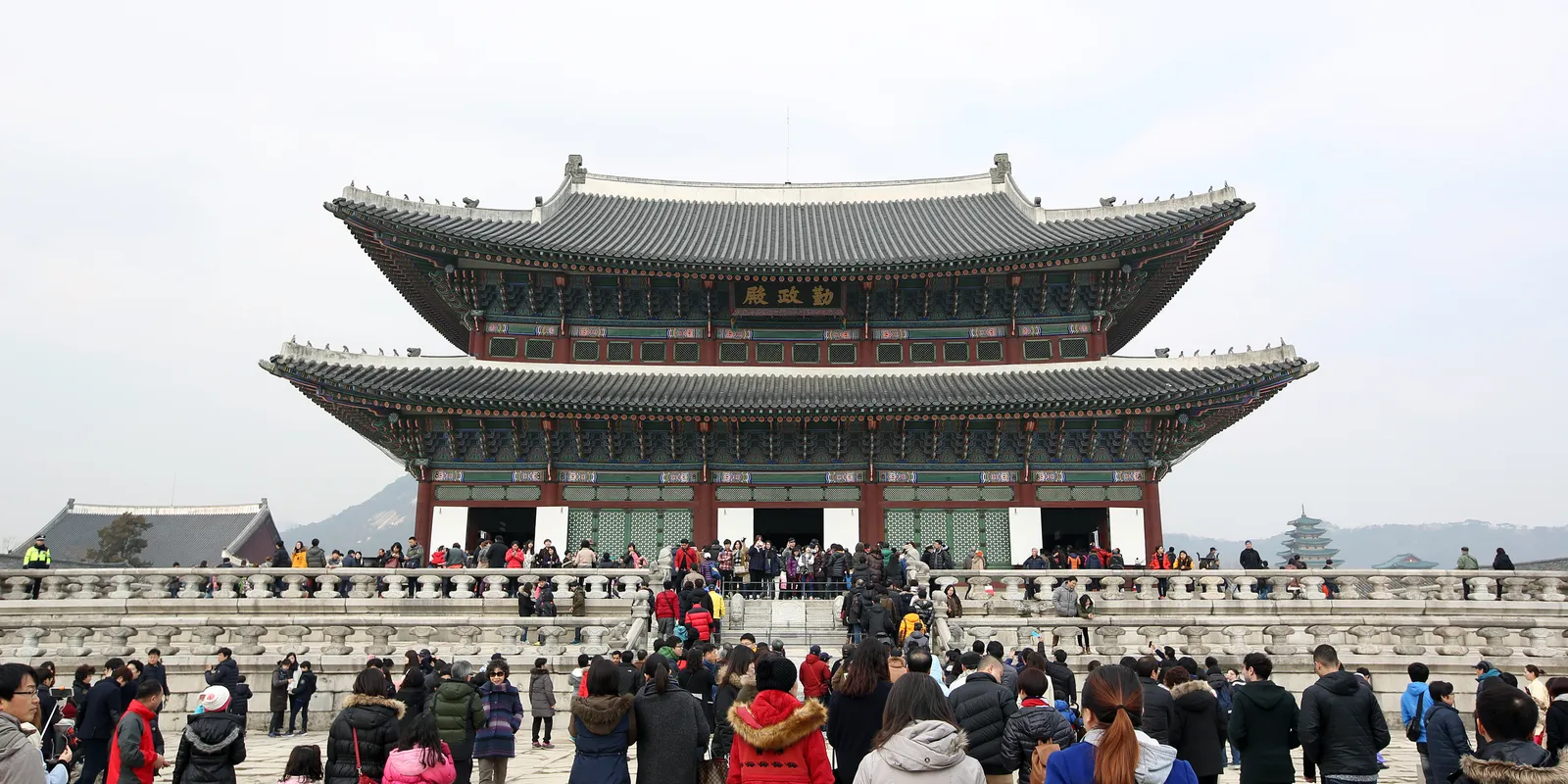
Open on all four days by the palaces' own closing-day rule; whether entry is free is not yet announced for 2027, though it was in 2026. The rule is on the Royal Palaces and Tombs Center's hours page: Gyeongbokgung and Jongmyo Shrine close on Tuesdays, Changdeokgung, Changgyeonggung and Deoksugung on Mondays, and "if the regular closing day falls on a public holiday or substitute holiday, the palace opens", the next non-holiday becoming the closing day. Monday 8 and Tuesday 9 February 2027 are both holidays, so the first day a palace can close is Wednesday 10 February. In 2026 the Korea Heritage Service went further, announcing on 2 February 2026 that the four palaces, Jongmyo and the royal tombs would open free from 14 to 18 February "without a closing day" (Newsis, 11 February 2026) and close on 19 February, the day after (Korea Tourism Organization, below KTO, 2026 Seollal guide of 11 February 2026); only Changdeokgung's Secret Garden stayed paid. No 2027 notice had been issued on 7 November 2026, when the Center's fee page still gave 3,000 won for Gyeongbokgung and Changdeokgung, 1,000 won for Changgyeonggung, Deoksugung and Jongmyo and 5,000 won for the Secret Garden, free in hanbok. The Service said on 5 August 2026 it meant to raise fees from 1 January 2027 (Yonhap); on 8 October 2026 SBS Biz reported the timing "undecided". Gyeongbokgung's winter hours are 09:00 to 17:00, last entry 16:00.
Does the National Museum of Korea close for the whole holiday or for one day?
One day: Seollal Day itself. The museum's English hours page lists three closures a year, 1 January, Lunar New Year's Day and Chuseok, with 2026 dates of 17 February and 25 September and no 2027 dates posted on 7 November 2026. So Saturday 6, Monday 8 and Tuesday 9 February 2027 are ordinary museum days, 09:30 to 17:30 or until 21:00 on the Saturday, with the permanent galleries free. An ordinary day there is in the National Museum of Korea guide.
Which shops and restaurants close?
In 2026 the department stores closed for two days, the hypermarkets mostly stayed open on shorter hours, the convenience stores mostly stayed open, and the small restaurants were the unpredictable part. Asia Economy's list of 14 February 2026 had almost every Lotte, Shinsegae and Hyundai department store closed for two days, most on 16 and 17 February and a few flagships on 17 and 18; the Starfield malls opened at 12:00 on the day itself (Newdaily, 14 February 2026). The hypermarkets did the opposite: E-mart closed 41 of its 132 stores on 17 February, Lotte Mart 33 and Homeplus 16, the rest opening from 11:00 (Asia Economy), while Costco closed every warehouse (Newdaily). CU and GS25 have let franchisees apply to close on the day since 2019 and 2020 (Newdaily, 20 January 2020), and KTO's 2026 guide says convenience stores and shops near tourist areas "often stay open". For restaurants the same guide is as precise as anyone gets: "Many department stores, malls, and restaurants close on Seollal Day or during part of the holiday"; a family-run place is best checked on a map app the day before.
How do the subway and buses run, and do the last trains move?
On the holiday timetable, and in 2026 Seoul kept its last trains running until 01:00 on Seollal Day and the day after. Seoul's own notice of 9 February 2026 had the last trains on lines 1 to 9, Ui-Sinseol and Sillim reach their termini at 01:00 on 17 and 18 February 2026, and the 121 bus routes serving the intercity terminals and main stations run to the same hour (Kukinews, 9 February 2026). On lines 1 to 8 it covered Seoul Metro's own sections, so Korail-operated stretches may keep their normal last train; the 2027 plan was not out on 7 November 2026.
How early do KTX and express-bus seats sell out?
For Seollal 2026 Korail sold its advance seats in one week in mid-January, and 59.7% of them went in that window. The schedule, announced on 7 January 2026 (Korea Economic Daily), covered trains from 13 to 18 February, with general booking from 19 to 21 January through the Korail app and website, for railway members only. By the close on 21 January 59.7% of the seats were gone (SBS Biz, 21 January 2026); the 2027 dates had not been announced on 7 November 2026. KTO's guide says express-bus tickets "sell out fast" too. How a visitor registers and books on Korail's English site is in where foreigners book KTX tickets.
During the holiday the phone is the only timetable there is. On the evening of Monday 8 February, with the Korail app open for a returned seat on a Tuesday train and Seoul Metro's page open for a last train that was not extended, the connection is a Kedanto Korea eSIM, and it is data and nothing more: the seat map, the station notice and the bus arrival board load on it, but it has no Korean number, so if the app wants to text you a one-time code, that text is looking for your home SIM, which has to be switched on and roaming to catch it. Put the eSIM on the phone at home, whenever suits; nothing on it is used up until the first Korean network picks the phone up.
With every bank branch shut, where do you change money?
No bank branch opens on a public holiday, so from Saturday 6 to Tuesday 9 February 2027 the counters are the airport's and the machines are the convenience stores'. KTO's public-holidays page, last updated 27 March 2026, says it in one line: "offices and banks are closed but palaces, museums, department stores, and amusement facilities are open". At Incheon Airport the exchange counters are what matter: the airport's facility list has KB Kookmin and Woori counters in Terminal 1 at 00:00 to 24:00 and Hana's at 06:00 to 22:00, and Metro Seoul reported on 12 February 2026 that all three would run them through the Seollal holiday without a closing day. In the city, the ATMs inside CU, emart24 and 7-Eleven run 24 hours and take Visa, Mastercard and UnionPay, as set out in which Korean ATMs give cash on a card from home; a bank counter means Friday 5 February.
What if you fall ill over the four days?
Clinics and pharmacies open on a rota published a few days before, and the emergency rooms do not close. For the 2026 holiday the Ministry of Health and Welfare said on 14 February 2026 (Newsis) that 4,955 clinics, hospitals and pharmacies would open on Seollal Day itself and that 416 emergency medical institutions would run 24 hours as usual, with the open ones listed on the Emergency Medical Portal (E-Gen) and 119 for anything serious. The 1330 helpline interprets in English, Japanese and Chinese 24 hours a day on KTO's page, and what a data-only phone can do with 119 is in calling 112 or 119 on a data-only eSIM. By Friday 5 February the palace question has already answered itself, through the closing-day rule. The one still open is the pharmacy: which of those near your hotel is on the rota for Sunday 7 February, and the rota, once published, is what E-Gen shows.
Sort your data out before you fly
You keep your SIM and add one data line. Your home number stays on your usual SIM; whether its calls and texts reach you abroad depends on your home carrier's roaming.
See eSIMs by countryRead next
- Seoul's free Wi-Fi covers markets, parks and buses, not the walk between them
- The ice rink that fills Seoul Plaza each winter, from the ticket and the helmet rule to the days bad air closes it
- If it snows in Seoul, ride the subway: peak service runs 30 minutes longer at a heavy snow advisory and 60 at a warning
- Packing for a Seoul winter when January mornings average −5.5°C and the subway is heated to 18°C